Thursday, November 9, 2023

Catwoman: Lonely City


Catwoman: Lonely City
by Cliff Chiang
2022
 
 
Catwoman: Lonely City is an excellent superhero comic, one of the best I've read in the past few years. The 'present day' of the comic is set 10 years after a traumatic event that separates it from the main DC comics continuity. Like The Dark Knight Returns and Old Man Logan, this is a comic that follows a protagonist who's come out of retirement to travel through a dystopian near-future world for one last job.
 
On 'Fool's Night,' the Joker arranged for a flash mob of ordinary but aggrieved Gotham citizens to don Halloween clown masks and commit a wave of robberies and assaults all over the city. Meanwhile, Joker himself put on a bomb vest, and committed suicide by blowing himself up, killing Batman and Commissioner Gordon in the process. Catwoman was helping Batman, but was blamed for his death, and spent a decade in prison.
 
Lonely City starts at the end of that decade, with Catwoman released from prison, returning to a Gotham that's been transformed by the city's response to Fool's Night. A reformed Two-Face is now the mayor, and looking for an excuse to re-arrest Catwoman to help his reelection campaign against a wheelchair-using Barbara Gordon. Masks are banned citywide (even on Halloween), everyone's movements and spending are tracked by their G-Buck wristbands, and Bruce Wayne's donated fortune has funded numerous good works ... and some incredibly heavily armed and armored police. Barbara Gordon's campaign promises to reduce the over-policing of the Gotham's communities of color, and inspired by Catwoman's release from prison, protesters wearing illegal cat masks turn up to picket sites of gentrification.
 
For her part, Catwoman wants to break into the Batcave, to try to understand Batman's last words to her before he died in her arms. She needs to practice her gymnastics and get back into shape, (and do so without wrecking her aging knees), and she needs tools and allies, and the funds to pay for both, if she's going to get past the Batcave's elaborate security. It's the last thing of Batman's the city hasn't been able to claim, even after his real name and life story have become common knowledge. And, oh yeah, she needs to avoid getting arrested again before she finishes this final heist.
 
This dynamic, of Catwoman gathering allies and committing smaller crimes to collect the resources she needs for her one last big crime, while trying to stay out of reach of a mayor and police force who know she's guilty but can't prove it, yet, defines much of the action of the book. Early on, she connects with a costume designer to get a new outfit, and tries stealing an abandoned Green Lantern ring to circumvent all the Batcave's defenses at once. When that fails, she reconnects with Killer Croc, the Riddler, and some other familiar faces.
 
Eventually, there's a climactic race to the finish, as Catwoman makes her attempt on the Batcave, and learns the meaning of Batman's last wishes, while Two Face sends the cops en masse to Wayne Manor to catch her in the act. Without spoiling exactly what happens, let me say that Catwoman makes a kind of personal peace with the conflicted emotions that have been driving her throughout the book, and that she's able to make an impactful decision about what to do with Batman's legacy.
 
Lonely City is part of DC's Black Label line of comics for mature audiences. Beyond the violence and swearing, what's most adult here is really the themes - surveillance and control and over-policing, scapegoating the poor and racial minorities for political benefit, and the emotions - regret, mourning, and ultimately acceptance of human mortality. Plus, Catwoman defeats a lot of the police profiling simply by being more analog than the system is prepared for - using cash and a flip phone, staying off social medial and away from electronic banking, which I think you maybe appreciate more if you also used to do the things she still does, because her habits were paused by her time in prison.

Monday, November 6, 2023

The Plain Janes


The Plain Janes
by Cecil Castellucci
art by Jim Rugg
2007
 
 
The Plain Janes is a young-adult graphic novel aimed, I think, at kids growing up in the aftermath of 9/11, in the pervasive fear and parental over-protection of that time.

Jane is a high school freshman whose family has just moved to the suburbs in the aftermath of a bombing in the city. I say I think this is a 9/11 analogy because it's an American comic released in the 2000s, but the details are vague enough that you could see parallels in any number of terror attacks. Jane was close to the site of the bombing, and while she was in the hospital, she started a one-sided relationship with a John Doe coma patient who was next to her when she woke up. Throughout the book, Jane's internal monologue takes the forms of letters she writes to this unconscious young man.

In the city, Jane had long blonde hair and popular friends. But after the attack, she gave herself a pixie cut and dyed it black, and at her new school, she rejects the advances of a popular girl who's much like her former self, and tries to befriend three outcast girls who sit apart, together, and eat their lunches in silence. They're all named Jane. Several attempts to befriend them fail, including trying out for Science Club, the school play, and the soccer team in the hope of winning over nerd Jane, theater Jane, and jock Jane.

Then Jane (art Jane?) gets an idea to do a guerilla public art installation on an empty construction lot. Rather than trying to join the others, she recruits them, getting them interested and excited in her new project. The secretly form PLAIN, People Loving Art in Neighborhoods, and take on more projects, all whimsical public displays. The police overreact, calling these "art attacks" and declaring a public curfew. Jane's traumatized mom also panics and grows more possessive.

Jane gets a crush on a cute guy who is also a loner and outsider at school. The other Janes all find themselves becoming more confident. And PLAIN, despite its general secrecy, gets at least one surprise recruit. An interesting turning point comes when PLAIN starts advertising participatory events, for example, asking everyone to sing at a specific date and time. The town's teens, bristling under all the new restrictions and collective punishments the school and police have been handing down, are happy to join in. What started as a playful solo art show becomes a collective resistance to unjust authority.

I think, somehow, this year I've been enjoying a multimedia subgenre of coming-of-age stories about girls forming or joining clubs. This and Loveless and This is How We Fly and Six Angry Girls, but also the movie Whip It, and anime like Laid Back Camp and Do It Yourself and Keep Your Hands Off Eizouken. Mostly by accident, I've found a series of stories that would've been excellent advice to my younger self, (and that still resonate with me today as I increasingly try to return to the world after the Covid lockdown) - go out, find friends, do things together.

I hope there are comparable stories addressing boys and young men, because if anything, they are even more lost and lonely than their femme and enby peers, and the hateful rightwing radicalization offered by the online Manosphere should not be the only voice showing them a path to camaraderie, companionship, and a cure for being alone.

Tuesday, October 31, 2023

Gideon the Ninth


Gideon the Ninth
by Tamsyn Muir
2019
 
 
Gideon the Ninth is obviously very popular, and some of my friends absolutely love it. My initial reaction was a sense of alienation from the text - at first Muir seems to be targeting a specific audience, and despite being a queer woman in the Millennial age range, I don't think I'm part of it. In the early chapters, Gideon the book seems to borrow from the tropes of fanfiction, and Gideon the character talks like a Very Online person posts. Muir's close third person narration, centered on Gideon, adopts the same sort of netspeak whenever she needs a metaphor or analogy. I did warm up to the book though, and really enjoyed it from about page 150 onward.
 
The book starts out on the sepulcher homeworld of the Ninth House, one of eight royal families who each have their own planet, ruled by very Catholic-seeming necromancers, who serve the Immortal God Emperor of the First House. The Emperor's self-resurrection, ten-thousand year reign, and unceasing interplanetary war against unspecified enemies bear more than passing resemblance to Warhammer 40K.
 
Harrow is the royal daughter of the Ninth House, and Gideon is a commoner and indentured servant with the demeanor and vocabulary of someone who spends about 12 hours a day on Twitter and Tumblr, although what she actually does is practice swordfighting. How it's possible for Gideon to be the way she is is never addressed, you just have to accept it. 
 
Harrow and Gideon are both in their late teens, and are the only two people under 40 on the whole planet. This ominous fact is stated once, early on, and then rarely referred to again until about 300 pages later, when we get the official version of what happened, and then the truth like 1 page after that. So the amount of foreshadowing and pace of information reveal could've been better, in my opinion. 
 
Because they are the only two children, Harrow and Gideon grow up a bit like sisters, but with a vast inequality in their relationship that makes them seem like rivals who hate each other at the start of the book. Early on, I assumed they were in an enemies-to-lovers romance arc, which is basically a fair statement of their trajectory. To make sense of their behavior, I think you have to be pretty familiar with that trope, and/or assume that they always loved each other but neither knew how to express it, or else their eventual reconciliation and pairing seems awfully fast and not well supported by events shown in the text.
 
Okay, so, the Emperor invites one necromancer and their sworn cavalier from each House to come to the First House and learn to be his new Lyctors, since the original immortal house-founders are finally ready to be replaced. Harrow's actual cavalier flees the planet, so Gideon is recruited to tag along and pretend to be Harrow's faithful, loyal servant, in exchange for freedom from her indenture afterward. To help with the ruse, Harrow also orders Gideon to pretend to be a nun under a vow of silence.
 
Pairs from each of the eight Houses gather in the disused and gigantic First House building, where they're told that they're there to learn how become Lyctors, and that the first thing they'll have to learn is how to learn that. Harrow sneaks off to start studying immediately, and Gideon is a mute witness to everyone else's interpersonal drama without really understanding any of it. 
 
One thing that's clear is that the Ninth House is unusually small, devout, and isolated, like a remote convent. The others are still necromantic royalty, but they vary in their degrees of ceremonial pomp, religious intensity, kindness and cruelty, and most of them know each other from previous state dinners and the like. Everyone's last name is based on their House number, which is convenient for a reader trying to keep track of the large cast, and also contributes to the tongue-in-cheek nature of the worldbuilding. The characters all take themselves very seriously, but Muir has set them in something like the Adventure Time version of the 40K universe.
 
For me, the point where things finally really got interesting was when Harrow realizes that she can't do this alone, asks Gideon for help, and starts sharing information. We get some very D&D-esque scenes where the pair explores the halls of the labyrinthine First House looking for secret doors, then studying tableaus of objects trying to discern what they indicate about the previous occupants. 
 
The way Harrow and the other necromancers learn here is to find preserved ten-thousand year old laboratories where they can repeat key necromantic experiments that show them how to cast new spells. In what feels like a nod to Jack Vance, the spells are essentially equations or proofs - math that has become magic. The labs date to a time just before the Empire, and belong to a world that's recognizably the near-future of our own contemporary Earth. The experiments all require cooperation between necromancer and cavalier, which forces Gideon to trust her body and spirit to Harrow's magic, which she does more readily than you'd expect.
 
And this is the other interesting thing about this section. We finally get to see who Gideon really is, as revealed by her actions, rather than her words, ironically, especially so once she discards the fake vow of silence. Gideon talks like a shitposter and fancies herself a super cool tough-guy badass, but behind her bravado, we eventually see someone who's much kinder (and much more vulnerable) than she thinks she is. She's also kind of a pushover for any pretty girl who's nice to her. My regrettable tendency to see reflections of myself in fictional red-heads led me, in spite of my initial annoyance, to sympathize a great deal with the Gideon we see in the latter half of the book.
 
The final element of the plot, that adds time-pressure to everyone's search for new spells, is that about halfway into the book, necromancer-cavalier duos start turning up murdered, and suddenly we're in an Agatha Christie And Then There Were None style locked-room mystery. I didn't care for this development when it cropped up in Seanan McGuire's Every Heart a Doorway, but it really works here. Interestingly, to me at least, despite the fact that everyone's magic is powered by death energy, and they've mainly learned it so they can go off and fight in whatever war the Empire is engaged in, they're all shocked by the murders and consider the killings to be immoral.
 
So, the femslash romance, the magic school competition, and the whodunnit plots define the middle and most interesting section of the book. Initially you wonder if it's Obvious Suspect, before eventually discovering that no! it was Unlikely Suspect all along. This is another area where I think Muir leans on her audience's familiarity with the tropes to make up forestall questions you might ask based on what she wrote alone. Because I think Unlikely Suspect does a few things that are difficult to square with the eventual revelation of their guilt. It's clear Muir knows the tropes well and is skilled at playing with them, but I wish she didn't seem to lean on them to supply logic to actions whose motives she doesn't explain herself.
 
Once all three plots resolve, what we get for the last 50 pages or so is one long climactic fight-for-your-life fight scene. And to give Muir credit, she certainly knows how to write action. If someone wanted to make a movie out of this, I think they'd be happy with the tour de force boss fight that caps off the story.
 
This is an ongoing series, and to judge from the fan response, continues to improve after the first book. I haven't decided if I'll continue. Certainly not right away. I am glad I stuck with it through my initial reservations and doldrums, because once the pace picked up and the stakes of the story were revealed, I really liked reading from that point on.

Wednesday, October 25, 2023

Tokyo Jazz Joints


Tokyo Jazz Joints
by Philip Arneil and James Catchpole
2023
 
 
I think the best way to enjoy Tokyo Jazz Joints is probably while drinking a cold beer and listening to a jazz album. Coltrane seems to be quite popular at the venues in the book. This is a photo book, which documents Arneill and Catchpole's visits to hundreds of jazz bars and cafes in Tokyo and across Japan.
 
The book opens with essays by Arneill (who took the photos, and seems to have been the driving force behind the project) and Catchpole (an aficionado who acted as the tour guide.) Both speak fondly of the jazz joint as a place where the owners are serious fans who've amassed and catalogued enormous collections, and where the customers enjoy both the music and a space of freedom from the structures of work and home life.
 
The rest of the book is photos of the pair's favorite sites. I think each joint appears multiple times. Arneill seems to be aiming for a kaleidoscopic effect, showing us everything, but in fragments. We see interiors of the spaces, the bars, the record collections, the sound systems, the music menus, the memorabilia, the front entrances and back exits, the framed photos, the bathroom graffiti.
 
My favorite shots are from a far enough distance to take in several features at once. Initially I was disappointed by some of the close-ups, though that feeling lessened once I realized they weren't the only images of any bar, and disappeared entirely deeper into the book, once I understood their purpose. A lot of these places are absolute dives, and seeing a faded door sign or a markered-up bathroom wall communicates that. And those images are only part of the mix, not the whole thing.
 
The one change I'd make, if I had the power, would be to include a bit more prose from Arneill and Catchpole. Both seem to be competent narrators, and I would've enjoyed hearing a bit more about some of the places they visited.

Monday, October 23, 2023

Galaxy


Galaxy
The Prettiest Star
by Jadzia Axelrod
art by Jess Taylor
2022
 
 
Galaxy: The Prettiest Star is probably one of the better-known of DC's young-adult graphic novels. It got some attention in the press for introducing a new trans character, and was nominated for a GLAAD Media Award. It's not really a superhero story at all, although the idea gets mentioned a couple times, and apparently Galaxy has appeared as a supporting character in some recent Hawkgirl comics.
 
Galaxy is metaphorically like a trans person, but what she literally is in the book is an alien princess who goes into something like witness protection, and is completely biologically transformed into a human boy as a disguise. When the story opens, she's been living as 'Taylor' for 6 years, watched over by a couple guardians who are disguised as her dad and older brother, and accompanied by an adorable talking corgi who records everything she does for security reasons. So she's not actually transgender in the way that I am, but she's living in a metaphor for trans-ness that can only happen in fantasy or scifi.
 
We're told that these disguises were chosen because Earth tv gave the dad guardian the idea that they'd be inconspicuous. Giving Galaxy a boy's body is another security measure. But the logic seems flawed since we're also told that the aliens hunting Galaxy can detect a crystal hidden in her chest, meaning she doesn't really need to appear human, or live in a town near a telescope where no one can use cell phones to avoid appearing on social media. All those measures seem mis-aimed, protecting against the wrong kind of threat. Which is convenient for the narrative, because it means when it's time, Galaxy can shake off all these precautions without consequence, since they never served a functional purpose.
 
Early on, we see Galaxy as Taylor going to school, playing basketball, experiencing something akin to gender dysphoria, and missing her dead parents and her previous life as a beautiful princess. A new girl comes to school from Metropolis, where aliens are common and accepted, and Galaxy gets a crush on her. Kat is Black, queer, has dyed green hair and a prosthetic leg, and no romantic interest in Taylor ... until Galaxy steals her guardian's push-button disguise device and transforms back into her alien body for the first time on Earth. After that, Kat and Galaxy start dating, and then Galaxy accidentally breaks the disguise device, which conveniently leaves her stuck in her alien femme form with no way to go back to looking human.
 
We get a montage of trans pain scenes after that. Galaxy fights with her guardians, gets kicked off the boy's basketball team, gets bullied at school by mean girls in the restroom and a lunchroom where no one wants her at their table, has a fight with her one previous friend, and gets expelled because the school board doesn't want to allow an alien to attend. (So, not even for changing gender.)
 
After all that, Galaxy is sad, argues with Kat, contemplates suicide, considers trying to wreck the school building, then makes up with her family and Kat, and the girls go to the homecoming dance together.
 
Jess Taylor's art is very colorful and has no outlines. It's a style that reminds me of some queer fan-art I've seen, as well as the webcomic Lore Olympus. I particularly like the way they rendered what humans look like through Galaxy's eventual alien super-vision. And it's cool that DC found a trans author and nonbinary illustrator to make their trans-friendly comic.
 
I have a sense that Galaxy is written more for non-trans audiences, to convince them to empathize with Galaxy, because she grew up as a non-trans girl on her home planet, then was forced to into a male body that is literally foreign to her and literally a disguise. She's very meek and polite, she doesn't intentionally cause a fuss. She's unable to stand up to her bullies, for example, and she only starts living as an alien because of an accident that leaves her unable to change back. She doesn't really decide; it just happens. Later she can stand up to her guardian because his security measures really were pointless and excessive, and again, because there's nothing any of them can do to reverse the transformation. 
 
So like, most of the potential points of conflict, or areas where Galaxy could have exercised agency, where it might've been possible for the audience to wonder if she was doing the right thing, have been written in a way that precludes any question or choice or doubt. These are authorial decisions that I suspect are aimed at persuasion, at simplifying a complex reality to an unambiguous metaphor that you can't argue with, so hopefully you just accept.
 
In a pretty short format, Axelrod is trying to tell a complete transition story - from vague dysphoria, to wanting to be a girl, to coming out to one person, experimental cross-dressing alone and with a trusted friend, to suddenly coming out to family and attending school as a girl, to experiencing initial rejection, to arriving at a place of self-acceptance. It's a lot of plot, especially combined with all the alien backstory. 
 
I think if I'd read it when I was a teenager, I probably would've felt Galaxy's story was a kind of wish fulfillment - I too wanted to magically and instantly have a non-trans woman's body, and to have everyone just have to accept it because it was an irreversible fait accompli. Sadly the reality is much slower and less satisfying than that. But maybe as a closeted teen, I'd have appreciated seeing the dream come true for someone. At the time, I didn't know there was a real, non-magical, non science-fictional path to go from being a teenage boy to being an adult woman. 
 
Today, as an adult who cannot possibly still be considered 'young,' what I want is less trans magic and trans metaphor, and more trans reality. But that's not really a fair demand to make of a YA superhero comic. So I hope that Galaxy's intended audience enjoys her origin story.

Saturday, October 21, 2023

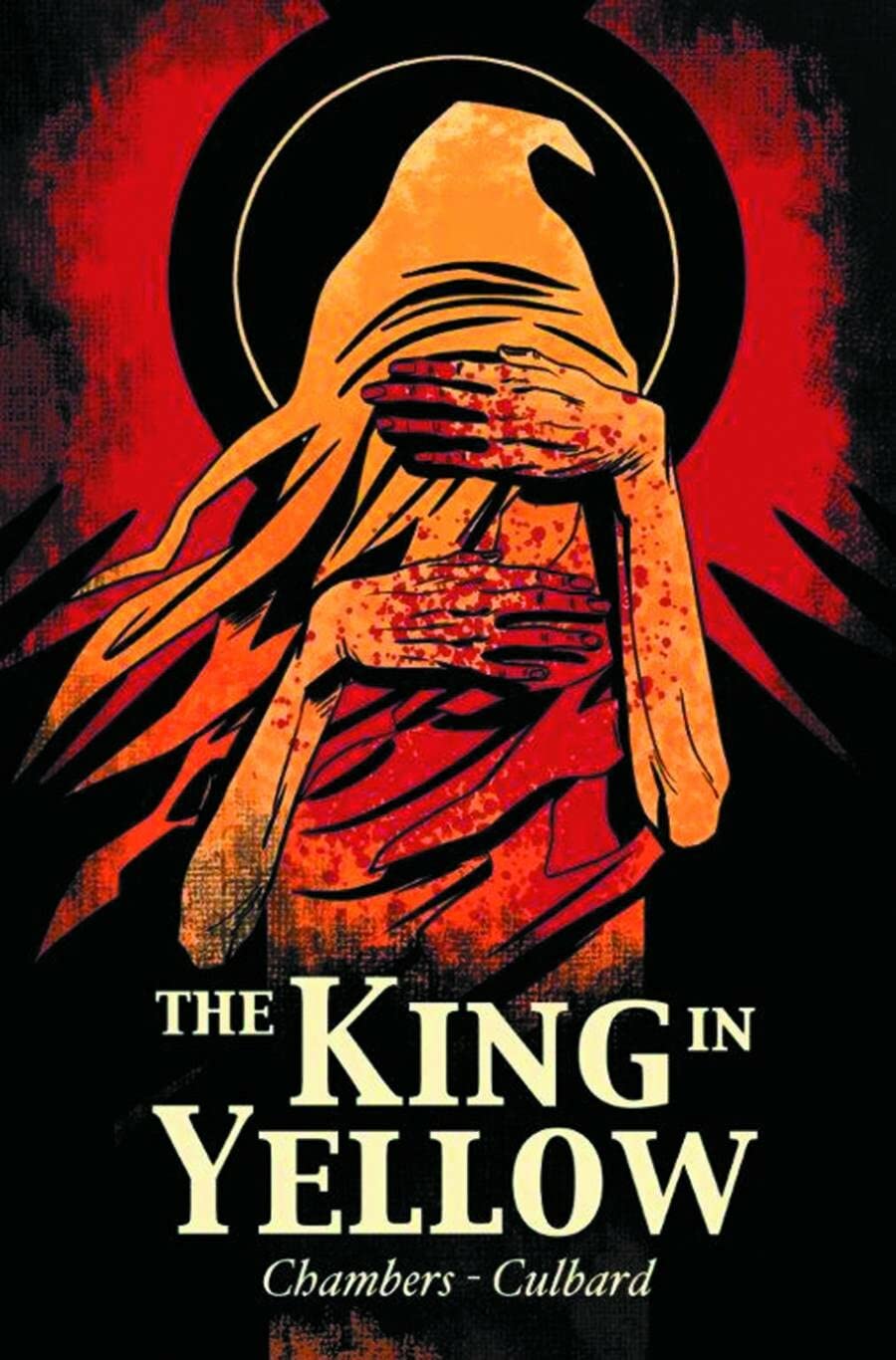
The King in Yellow


The King in Yellow
by INJ Culbard
adapted from the short stories by Robert Chambers
1895, adapted 2015
 
 
The King in Yellow is a graphic novel adaptation of the first four stories in Robert Chambers' 1895 collection of the same name, by British comics artist INJ Culbard.
 
Chambers' stories remain pretty well known among fans of weird fiction, inspiring, among other things, some of the imagery in the first season of True Detective, as well as the indie D&D adventure Carcosa. I know Culbard from his comic Brass Sun, but I gather he has a number of these illustrated adaptations.
 
The four stories each contain characters who read the fictional play The King in Yellow. Supposedly its performance and even script are banned, but it circulates by being passed from reader to reader. The first act is fantastical horror story, and Chambers introduces each story with an epigraph supposedly from Act I. The second act isn't directly described, except that people who start reading it aren't able to stop partway through. They're driven mad, and are compelled to share the script with others. People who've read the play seem to believe that The King in Yellow is a real person (or god), that they serve him, and that his symbol, The Yellow Sign, can be used to identify both fellow believers and the King's commands.
 
In "The Repairer of Reputations," Hildred is a troubled young man who was recently released from an asylum where he was kept due to severe personality changes after falling off a horse and hitting his head. He's convinced that he can be crowned as some sort of royalty, but that first he needs to kill his own cousin (whom he believes is a rival heir). I love Culbard's rendering of Hildred as someone with an overly intense stare, who very clearly unnerves the people around him. Hildred has read the play, and after the violent conclusion of his plan, it's mailed to a friend in Paris.
 
In "The Mask," the sculptor who reads the play develops a chemical that converts living matter into something like white marble. He likens this process to the sculptural equivalent of photography. After preserving a rose and a rabbit, he gets the idea to try his chemical on a person...
 
In "The Yellow Sign," the play next arrives by mail for another artist. He and his life-model girlfriend are both troubled by nightmares, and then both read the play, which makes everything worse.
 
Finally, in "The Court of the Dragon," the young man from the previous story, already mostly out of his mind, is tormented by visions and phantom music.
 
This is a nicely spooky adaptation. "The Repairer of Reputations" remains my favorite. It has elements of science fiction and alternate history, though it's sort of ambiguous if these are 'real' or symptom's of Hildred's madness. As a stand-alone, it's equally ambiguous if the play is special or just something he's fixated on. Its recurrence in the other stories is what makes the play's power over its readers definitively 'real,' as we see life after life ruined by reading it. Honestly, given Hildred's instability, it would be hard to take his beliefs seriously if not for the later stories, which retroactively lend him a bit of credibility.
 
Culbard makes a couple key changes, though I think they're faithful to the spirit of the originals. Most importantly, he treats these as four chapters of a single novella, rather than stand-alone stories. The young man from "The Yellow Sign" appears in both the earlier stories as a friend of the other characters who is alarmed by their fate. It is literally the same copy of the cursed play that is read and passed on each time. The final story (originally the third), is rendered nearly wordlessly, as this character has been driven mad, the pages filled with stylized musical notes and visions of the King.

The idea of the play The King in Yellow is still compelling today, I think. It's a kind of thought experiment, a book that probably should be banned. The idea of a text that, if you read it, changes you in a way that you can't prevent or reverse, remains frightening. It's probably the basis for David Langford's 'basilisk' stories and the contemporary 'cognitohazard' concept - it's a danger that you can only escape by avoiding all contact with it. There's no safe way to study the text without succumbing to it; worse still, you can encounter it entirely by accident simply by doing the thing we all do all day long - read text without knowing what it says already. I think it's that idea that keeps us coming back to Chambers over a century later.

Thursday, October 19, 2023

Deadly Quiet City


Deadly Quiet City
Stories from Wuhan, COVID Ground Zero
by Murong Xuecun
2022
 
 
Deadly Quiet City is a journalistic account of the 76-day lockdown of Wuhan in early 2020. This was a hard one for me to read, because my father died of covid, but it felt important too.
 
Murong traveled from his home in Beijing to Wuhan shortly after the lockdown ended in early April. He conducted interviews allowing him to report 8 people's stories. He was shadowed by the police. Another citizen journalist is arrested and disappeared, as is one of Murong's interviewees. He fled Wuhan to write in secret, handed his manuscript off to a trusted friend to smuggle out of the country, then he left the country as well. As far as Murong knows, he can't return to China without being arrested.
 
Each of Murong's accounts includes certain shared markers of time - the start of the lockdown on January 23rd, the Chinese New Year on the 25th, the death of whistleblower Li Wenliang on February 7th, and the Chinese Communist Party's subsequent efforts to transform him a popular hero who defied the government into a loyal Party hero, the cherry blossom season in late March, the lifting of the most severe travel restrictions on April 8th.
 
The first account in the book is based on an interview with a doctor at Wuhan Central Hospital, who knows by late December that there are an unusual number of pneumonia patients, with a new disease, that can spread from patient to caregiver, and that the CCP is censoring any mention of this information, both on social media, and even in any official hospital documents. The doctor himself gets sick, is forced to work while sick, fears he is infecting patients, and eventually barely survives his own infection.
 
Most of the people Murong talks to are cornavirus survivors, or people who lost a family member to the virus, or both. A wife loses her husband, a young man his elderly father, a mother her adult daughter. In each case, their condition or the condition of their loved one is made worse by the CCP's efforts to prevent the spread, not of the virus, but of information. In each case you can see how they became radicalized enough by what they experience to risk talking to Murong.
 
In many cases, it seems that the government official with the most proximate authority is perfectly content to let someone die without treatment, their biggest concerns are that the death be quiet, that it not be counted as covid, and that the surviving family members don't talk about it afterward. After the hospitals are overfull, hundreds are sent to "isolation centers," warehouses where they are provided only food, water, and a cot, but no medical care. When these centers get too much attention, the CCP empties them by sending in wave after wave of bureaucrats to each send home the healthiest remaining patients, until none are left.
 
Murong also talks to a man who drives an illegal motorcycle taxi, who provided invaluable service transporting people around Wuhan during the lockdown, when public transit was shut down, and taxis and private cars were forbidden except to the police and Party members.
 
And he talks to a woman much like himself, who smuggled herself into the city during the lockdown to try to conduct interviews, share information, and provide aid. At one point before Murong spoke to her, she was arrested and spent over a week in solitary confinement, in the dark, with her hands and feet shackled to the floor, eating and drinking from bowls, and lying in her own excrement. It was her second arrest that prompted Murong to flee the city.
 
I don't know if a more open or honest government could've prevented the global spread of Covid-19, but it's clear that China didn't even try to. (The WHO, the CDC, and the Trump administration bare similar guilt for similar reasons in my view, though by the time they got involved, it was already too late.) At every possible decision point, the CCP, from Xi Jinping down to the neighborhood committees, chose to hide and suppress and censor information, and to harass and arrest and persecute anyone who tried to speak up or tell the truth. 
 
Hospital staff were forbidden to wear PPE because that would create the appearance of a cause for concern. At one point covid test results were classified as state secrets, with doctors not authorized to see them. Causes of death are falsified to keep the numbers down. Over a month of inaction, in the lead up to New Years, when people traveled to and from Wuhan, when the only thing government did was to keep the disease a secret. People who had their social media posts deleted, their accounts canceled, who were visited and followed by the police, for saying what happened to them.
 
Even with my small online footprint, with my insignificant readership, I presume I would receive the same treatment if I lived there, under those rules.
 
If I read another book about covid in China, it will probably be Wuhan Diary by Fang Fang, a first-person account interspersed with interviews, originally published on social media. Fang's translator has been harassed and targeted online by some mix of sincere patriots and paid trolls, which is presumably why Murong's translator remains anonymous.