Showing posts with label horror. Show all posts

Saturday, May 30, 2026

The Creepy Case Files of Margo Maloo


The Creepy Case Files of Margo Maloo
by Drew Weing
2016 
 
 
The Creepy Case Files of Margo Maloo is a kids' comic about a boy who moves to the city, discovers it's full of monsters, then learns that monsters aren't as scary as he thought. 
 
Our viewpoint character is Charles, an aspiring journalist whose parents have just moved into a fixer-upper apartment in a former hotel. Echo City is on the coast; it's a bit economically distressed, though maybe things have recently improved. The titular Margo Maloo helps out other kids who have monster problems. Her main rules for helping are that the monsters were here first and have at least as much right to a peaceful life as the human kids do, and that you can't tell any adults about the existence of monsters. 
 
Creepy Case Files has three chapters. In the first, Charles sees a troll in his bedroom at night. A neighbor kid, who really wants to set a world record for like hopping on one leg or standing on his head, gives Charles Margo's business card, and she shows up to help negotiate a peaceful resolution. The troll's annoyed that the hotel's getting remodeled, but he and Charles find common ground in their love of little stuffed toys that definitely are not Beanie Babies. In the second chapter, inquisitive Charles gets Margo to agree to let him tag along while she helps find a lost kid in an abandoned restaurant that's haunted by a ghost. In the third chapter, Charles is falsely accused of kidnapping a baby ogre. (He's been seen snooping around, and monsters have trouble telling humans apart!) Margo finds the baby and clears his name, with Charles taking on a Watson-like role.
 
Charles's parents dress like former Gen X alternative kids. They're excited by the DIY opportunities, and the fact that unlike in their old small town, the can get quinoa in the grocery store here, and carry-out from Korean restaurants. I feel like author Drew Weing included those details for parents who are reading with their kids to enjoy. Also for grown-ups' benefit - Charles's dad trying to explain the fraught ethics of gentrification to an disinterested 10-year-old, and dad clearly worrying that his White son isn't getting along with the neighbors before realizing Charles is talking about monsters, which are obviously just make-believe. The neighbor kid who wants to set a record is Black, and it seems like they will be friends. Margo looks Mediterranean to me. She's too much of a loner to consider Charles a friend, but by the end of the book, she might accept him as a partner in this monster business. 

Tuesday, April 28, 2026

Anya's Ghost


Anya's Ghost
by Vera Brosgol
2011
 
 
Anya's Ghost is a YA graphic novel about a high school girl who meets a ghost who offers to help her get ahead, which forces her to reevaluate what kind of person she really wants to be. Vera Brosgol writes convincingly about the experience of feeling like a outsider and wanting to fit in. At first, the ghost seems like a shortcut to success, but of course, it's not really going to be that easy.
 
Anya is a Russian immigrant in her first year at a fancy private high school. After being bullied in middle school, for having an accent, for being fat, she's remade herself as someone who seems more like the other kids. She's still on the periphery - her only friend seems to be a tomboy who likes to sneak out of class to smoke - and she's afraid of being 'found out' and getting bullied again. She's ashamed of her mom, and desperate to not be seen with the nerdy Russian boy in her grade who still has his accent and tries too hard in class. She has a crush on an athletic boy, but his girlfriend is one of the popular girls, and neither of them seems to know she exists.
 
Then, in the park, Anya accidentally falls down an old well. She's trapped, and no one will even hear her yell for help unless they're right at the top. She could easily die down there, which is driven home by the presence of the skeleton of someone who actually did. The skeleton is haunted by a ghost who can't travel far from her bones. At first, Anya's frightened, then glad for the company, and then the ghost helps her get rescued by spotting someone close by and encouraging Anya to yell at just the right time.
 
Somehow, a finger bone from the skeleton makes it into Anya's school bag, allowing the ghost to follow her home. Since she died a hundred years earlier, the ghost seems pretty nerdy by modern standards, but she's curious about Anya's life and the world today. Anya's near-fatal accident gets her attention and sympathy at school, including from her crush and his girlfriend. The ghost starts helping Anya, giving her answers on quizzes, playing look-out so she can sneak off for a cigarette, and encouraging her to get an invite to the big weekend party all the popular kids will be at. The ghost even advises her how to dress to get attention from boys at the party...
 
The party doesn't go well. Anya learns some unflattering things about her crush that pretty much kill her attraction to him. The ghost, who's restyled herself to look like a popular girl, is angry that Anya's no longer willing to follow her advice or let her vicariously pursue a teen romance. At the library, with the help of the Russian boy she's always scorned, Anya finds an old newspaper and learns more about how the ghost died, which makes her realize she really doesn't want to take advice from this person...
 
At this point, Anya starts to reevaluate herself and how she's been acting. She's finally been getting what she thought she wanted - a taste of popularity. But she's been acting like a jerk, and she realizes, she was before too, especially to her mom and the nerdy boy. Meanwhile the ghost is getting stronger and more ambitious. She wants Anya to be popular so she can live out her own fantasy, and she doesn't care what Anya wants for herself. A confrontation is inevitable.
 
As I said, I like how Brosgol writes Anya, and how she sort of universalizes the immigrant experience in a way that almost anyone who was bullied when they were young, and who made a conscious effort to become less nerdy, should be able to relate to. Brosgol's black and white art expresses emotion really well, which is important for this story. Making the ghost pure white with grey outlines also helps her stand out as otherworldly amidst the darker lines and shading of the living world. 

Monday, January 26, 2026

The Rider, the Ride, the Rich Man's Wife


The Rider, the Ride, the Rich Man's Wife
by Premee Mohamed
2024
 
 
The Rider, the Ride, the Rich Man's Wife is a novella that blends science fiction and horror to tell a new version of a classic tale about human sacrifice meant to bring good weather. But unlike in "The Lottery", for example, there is a true supernatural threat here, not solely the indifference and cruelty of one's mortal neighbors.
 
In the post-apocalyptic future, twin brothers Lucas and Kit live in a farming village that ekes a living from the parched landscape. Once every seven years, the town gets absolutely deluged with rain, which heralds the arrival of a pair of hungry ghosts, the Rider and the Wife. Each time the heavy rains come, the ghosts appear and place a mark on their prey. The next morning the hunt begins. If the prey can survive until sunset, supposedly they'll be free, but if not they'll become the next Rider. No one is allowed to help; anyone who interferes will be killed immediately.
 
When Kit is chosen though, Lucas isn't willing to let his brother die without trying to help. They make a plan. Instead of running toward the river as people usually do, Kit will run to the distant city, abandoned when civilization fell. And Lucas will meet him there.Together, perhaps the can out-run, out-hide, out-think, and maybe even out-fight the Rider and the Wife. Of course it's not really that easy, and what they find in the city is much stranger and much older than they possibly could've prepared for. Almost the whole book is devoted to the chase, with only a little scene setting before it starts, and a glimpse of the aftermath after it ends at sunset.
 
Author Premee Mohamed maintains a frantic pace as the brothers try to keep ahead of undead hunters on horseback and their horrible, monstrous hounds. Just as she did in The Butcher of the Forest, she describes the otherworldly in language that's visceral and immediate, making her ghostly creatures feel disturbingly lively. If I have one complaint, it's that the worldbuilding is so expansive that the tale seems dwarfed by the world it's set in. There might even be a connection to the otherworld of The Butcher. That's much better than the author having too little imagination though, and the unexpected sprawl of the scenery never detracts from the urgency of the pursuit. 

Tuesday, October 29, 2024

The Butcher of the Forest


The Butcher of the Forest
by Premee Mohamed
2024
 
 
The Butcher of the Forest is a dark fantasy novella, a fairy tale so grim that it slides into horror. Author Premee Mohamed has delivered the literary equivalent of the filmmaker's 'tight ninety' - a book that is taut, lean, and well-edited, where every scene advances the story, and every bit of action feels 'right' and appropriate and inevitable. This book is both excellent and economical, and has a literary heft that belies its slim size and its clear, readable prose.
 
From the moment Veris is awoken in the night by armored guards who drag her, in her nightgown, to a carriage to see the Tyrant who rules her village and all the surrounding lands, you know that things are going to go badly for her. And when the Tyrant himself tells her that his two children have wandered out of the palace and disappeared into the Woods, a cursed forest that absolutely no one - except Veris - has ever returned from alive, when the Tyrant tells her to go back in, and to do the impossible by returning with his children, and to do it all in a day or he'll slaughter her entire village as punishment, when that happens you know this is not going to be a story with a happy ending. The only questions are what will go wrong, and how bad will the consequences be? I was fully prepared, for example, for Veris to be successful but too late, and to come home to a village burned to the ground.
 
The edge of the woods are safe, but inside the mortal woods are another, different, otherworldly woods, and there's no obvious barrier or way of knowing when you've crossed from one to the other ... except until after you've gone too far. There are beings that live in the woods, that are sort of like people, but also very, very strange. Mohamed hasn't written any elves or faeries, nothing so safe or recognizable. Nothing with a name, except the unicorn, who's the most monstrous thing in there.
 
More than anything else, Mohamed's treatment of magic and supernatural creatures reminds me of SM Wheeler's novel Sea Change, which isn't even a helpful comparison, because hardly anyone else has heard of it or read it. But what I mean is that all the creatures of the forest are weird, and powerful, and dangerous, and Veris and the kids, when she finds them, are achingly vulnerable, nearly helpless, except for what they can get by being polite, and clever, and quick. But if something from the forest catches you, and it has you by rights of you breaking a rule - no cutting wood, no spilling blood, all deals will be unfair, no cheating or arguing or else they become unfairer still - there's nothing you can do, no way to fight, no way to win by strength.
 
So, Veris enters the woods. Through trials and by her own wit and determination, she finds the kids, and through more trials and hardships she leads them back toward the edge of the forest, back to reality, and their home, the castle of the Tyrant, as the day wanes, and time runs out, and you know it won't be quite that easy or straightforward... Time maybe passes differently in the forest, but Mohamed skillfully takes from morning to afternoon through a long evening into the night, without ever stating the phase of the day, just with the mood and the colors and the light. It's just one of many impressive things about what she's written here.
 
Along the way, we learn a bit about Veris and her village, about the Tyrant, how he fights, how he wins and conquers, about what happened to Veris when he first arrived, and she was just a girl, and her parents were still living, about why she came into the cursed forest the first time, before she knew she'd become a legend by making it back out. There's not a lot of worldbuilding here, but as with everything else in this jewelbox of a book, there's the right amount, there's just enough. We learn just enough about the cruel logic of the woods and its denizens, see just enough adventure as Veris passes through, see just enough of flashbacks and of the wider world.
 
This is a good one. You might give it a miss, if you think it's too dark. But if you like this sort of fantasy, combining realistic politics of conquest with unsettling and uncanny glimpses of the supernatural, this is an easy and rewarding pick.

Friday, May 31, 2024

These Lifeless Things


These Lifeless Things
by Premee Mohamed
2021
 
 
Premee Mohamed's novella These Lifeless Things takes place across two time periods. In the near future, or alternate present, strange monsters invade the Earth and kill billions, knocking out the internet and electricity, wrecking most of our cities, and wiping out more than 99 percent of our population. A half century later, the brief invasion and near-extinction is known as the Setback, the millions of survivors and their descendants have rebuilt society, complete with universities, researchers, and grants that fund fieldwork in the ruined cities.

The thread that connects the two is a diary, written by survivor Eva from within one of the besieged cities, and discovered afterward by Emerson, the lone social scientist on a research trip into the city. About ⅔ of this 150 page book is the text of the diary, as Eva negotiates her unrequited crush on a fellow survivor, worries about a possible collaborator in their midst, and plots a desperate attempt to find and rescue kidnapped children. In Emerson's portions, she tries to locate sites Eva mentioned, thinks about the value of history and how this first-hand account updates what's already known about the Setback, and copes with the condescension of her colleagues in the natural sciences. Both women feel isolated, both think about survival and extinction, both want their lives to have meaning, to make a contribution.

The invading monsters Mohamed describes are kind of archetypal 'eldritch horrors,' but she describes them creatively enough to avoid them feeling generic. They come not from outer space, but from another dimension. They manifest only partially and temporarily, flickers of tentacles and stingers, unknowable, impossible to communicate with. They transform some plants into living weapons, and somehow 'possess' our metal and stone statues, changing their shape and bringing them to life as host bodies. No one knows where they came from, why they killed, why they left, or when or if they'll be back.

Mohamed's characters think about the similarities between this alien invasion and the history of human violence. The unnamed city where the story takes place is almost certainly in Ukraine, and might be Kyiv. At one point, Eva thinks about Chernobyl, and Mohamed writes "Isn't it funny that that was virtually the only thing the world knew about us, when they thought of us at all, and it took the Invasion for the entire world to start thinking about the same thing all at once. Solidarity at last." A bit later, when thinking about the Nazis, the Soviets, all the human invasions that preceded the alien one, she writes "Silence fell while we thought of how we have all been overrun, how this land has always been under someone's thumb ... What people want, always, is to conquer. To take what belongs to the seemingly weak or the outnumbered or the outgunned, to take from the other."

Mohamed wrote this book before 2022, which makes it seem really prescient, until you remember that Putin's Russia first invaded Ukraine in 2014, and that many in the US and Canada simply chose to ignore it then, which makes this less a successful prediction, and more an empathetic acknowledgment of a present reality. I've seen a review of Mohamed's new novella The Siege of Burning Grass, which she wrote before the start of Israel's recent destruction of Gaza, that notes profound parallels between her plot and the violence there, and credits her with foresight. I'm not sure that's it though. Awareness of, and willingness to face, known but neglected truths might be more powerful than the ability to make rigorously accurate predictions, honestly.

My one complaint is that I think These Lifeless Things lacks a satisfying ending. Eva stops writing her diary and hides it; Emerson goes home to the university. You sort of know what will happen next to both of them, but to me it still felt kind of incomplete.

Saturday, October 21, 2023

The King in Yellow


The King in Yellow
by INJ Culbard
adapted from the short stories by Robert Chambers
1895, adapted 2015
 
 
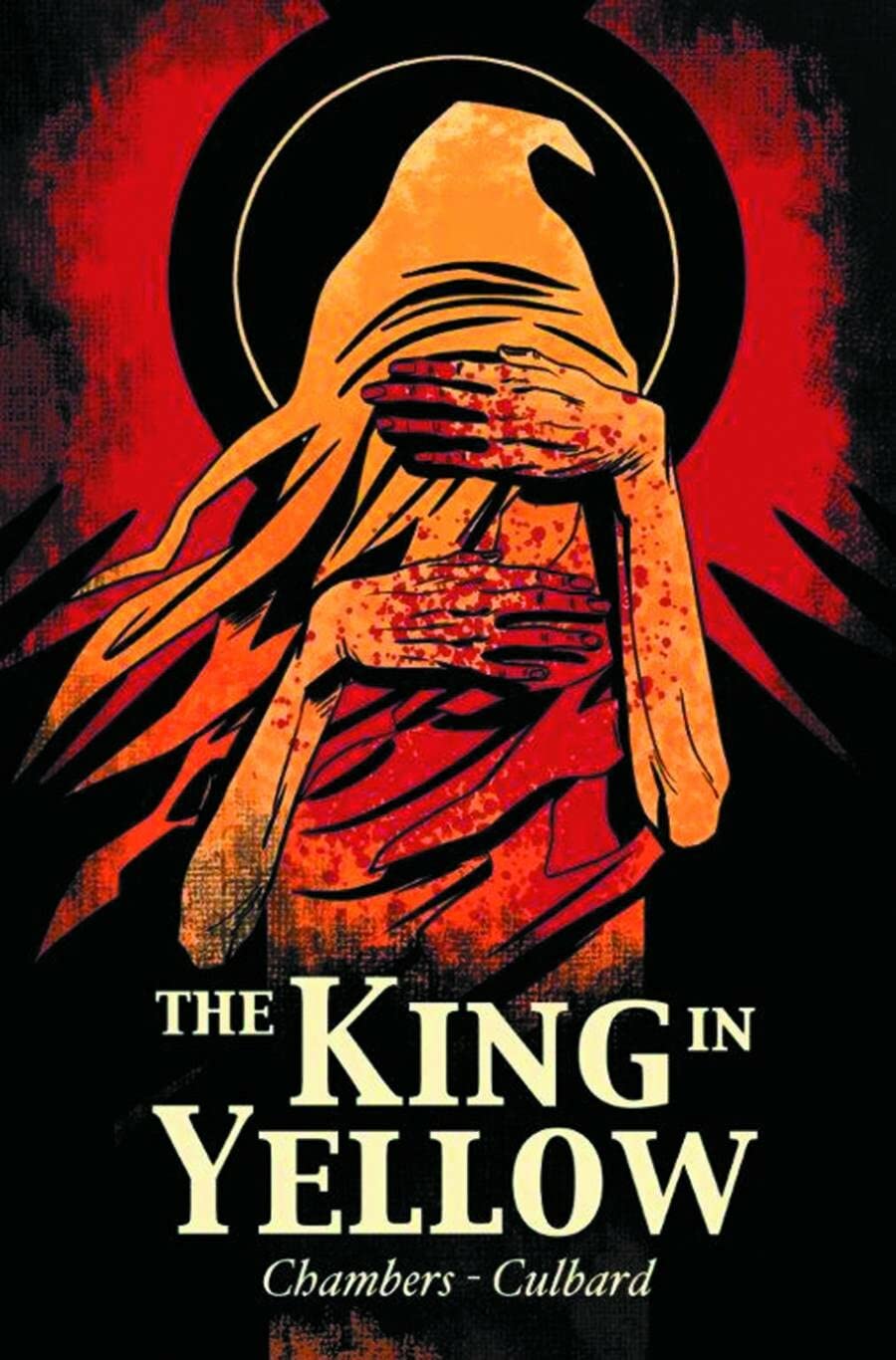
The King in Yellow is a graphic novel adaptation of the first four stories in Robert Chambers' 1895 collection of the same name, by British comics artist INJ Culbard.
 
Chambers' stories remain pretty well known among fans of weird fiction, inspiring, among other things, some of the imagery in the first season of True Detective, as well as the indie D&D adventure Carcosa. I know Culbard from his comic Brass Sun, but I gather he has a number of these illustrated adaptations.
 
The four stories each contain characters who read the fictional play The King in Yellow. Supposedly its performance and even script are banned, but it circulates by being passed from reader to reader. The first act is fantastical horror story, and Chambers introduces each story with an epigraph supposedly from Act I. The second act isn't directly described, except that people who start reading it aren't able to stop partway through. They're driven mad, and are compelled to share the script with others. People who've read the play seem to believe that The King in Yellow is a real person (or god), that they serve him, and that his symbol, The Yellow Sign, can be used to identify both fellow believers and the King's commands.
 
In "The Repairer of Reputations," Hildred is a troubled young man who was recently released from an asylum where he was kept due to severe personality changes after falling off a horse and hitting his head. He's convinced that he can be crowned as some sort of royalty, but that first he needs to kill his own cousin (whom he believes is a rival heir). I love Culbard's rendering of Hildred as someone with an overly intense stare, who very clearly unnerves the people around him. Hildred has read the play, and after the violent conclusion of his plan, it's mailed to a friend in Paris.
 
In "The Mask," the sculptor who reads the play develops a chemical that converts living matter into something like white marble. He likens this process to the sculptural equivalent of photography. After preserving a rose and a rabbit, he gets the idea to try his chemical on a person...
 
In "The Yellow Sign," the play next arrives by mail for another artist. He and his life-model girlfriend are both troubled by nightmares, and then both read the play, which makes everything worse.
 
Finally, in "The Court of the Dragon," the young man from the previous story, already mostly out of his mind, is tormented by visions and phantom music.
 
This is a nicely spooky adaptation. "The Repairer of Reputations" remains my favorite. It has elements of science fiction and alternate history, though it's sort of ambiguous if these are 'real' or symptom's of Hildred's madness. As a stand-alone, it's equally ambiguous if the play is special or just something he's fixated on. Its recurrence in the other stories is what makes the play's power over its readers definitively 'real,' as we see life after life ruined by reading it. Honestly, given Hildred's instability, it would be hard to take his beliefs seriously if not for the later stories, which retroactively lend him a bit of credibility.
 
Culbard makes a couple key changes, though I think they're faithful to the spirit of the originals. Most importantly, he treats these as four chapters of a single novella, rather than stand-alone stories. The young man from "The Yellow Sign" appears in both the earlier stories as a friend of the other characters who is alarmed by their fate. It is literally the same copy of the cursed play that is read and passed on each time. The final story (originally the third), is rendered nearly wordlessly, as this character has been driven mad, the pages filled with stylized musical notes and visions of the King.

The idea of the play The King in Yellow is still compelling today, I think. It's a kind of thought experiment, a book that probably should be banned. The idea of a text that, if you read it, changes you in a way that you can't prevent or reverse, remains frightening. It's probably the basis for David Langford's 'basilisk' stories and the contemporary 'cognitohazard' concept - it's a danger that you can only escape by avoiding all contact with it. There's no safe way to study the text without succumbing to it; worse still, you can encounter it entirely by accident simply by doing the thing we all do all day long - read text without knowing what it says already. I think it's that idea that keeps us coming back to Chambers over a century later.

Monday, October 9, 2023

The Curator


The Curator
by Owen King
2023
 
 
The Curator is a horror novel that initially masquerades as historical fantasy. Owen King provides us with a kaleidoscopic view of his world, showing rapidly shifting political events through the eyes of people on the ground. He has a large cast, but he returns to each of them enough, and has them run into each other enough, that the effect is a bit like a Dickens novel, or one of those hyperlink cinema movies where each of the lead characters has their own storyline but they all loosely intersect over the course of the film. King also gives us two different monsters, who represent failings of each side of the central conflict.
 
We open in an unnamed city, nicknamed 'Fairest,' where some almost fairytale narration informs us that there's recently been a revolution, and an alliance of workers, students, and homeguard soldiers have nearly bloodlessly routed the entire ruling class, who've all fled for safer environs. In the aftermath, the tripartite provisional government is busy seizing city property and private wealth alike, and redistributing it to the needy. 
 
Dora, a girl born rich, orphaned, and lately working as a maid in the university, manages to adopt the National Museum of the Worker and become the new curator of its wax figurines. Her goal is actually to learn more about her older brother, who died when they were children, but who volunteered at the Society for Psykical Research, and who told her he'd learned there were other worlds, and perhaps survival after death, right before the cholera got him. The Society is next-door to the Museum, but it burned down during the revolt.
 
That mix of the whimsical (the mannequin museum), the supernatural (we see a conjuring trick early on that proves something supernatural is afoot), and the deadly, prosaically serious (the vulnerability of the human body to mundane injury and death), is pretty consistent throughout, though the blend changes and gets darker the longer the book continues.
 
Although King's close third-person narration checks in on many characters, Dora is pretty central. She has a boyfriend who's a student and volunteer in the provisional government, a 'quick boy,' a teenage thief, has a crush on her and helps steal things around the city to refurbish the museum. There's a professional soldier with a grudge against her boyfriend who's decided to rape Dora in revenge, and in the unnamed but obviously America embassy next-door to the museum, a man working for the provisional government tortures servants of the rich to death for information every night, and he feels duty bound to kill his neighbor Dora too just as soon as he has an opening in his busy schedule. It's a volatile mix, certain to explode. Also Dora's search for information about her brother will eventually reveal the truth to her, as well as the basic mechanics of how the central supernatural conceit of the book works, and a form of exploitation that involves the direct transfer of the lives of the poor to the lifespans of the rich.
 
After the revolution, the city is closed but optimistic with anticipation. There's a blockade of royalist soldiers cutting off the main road in, but the home guard outnumber them, and will surely open the city soon, right? We see flashbacks of how the revolution started, endure the long interim period of waiting and dreams deferred that never seems to resolve, and then the sudden collapse of the provisional government as the royalists return in force at the end.
 
King balances the two sides of this conflict well. The city's poor and workers suffered pain, hunger, indignity, and early death under the old regime. The inequality was real and ugly, the urge to correct it, to share the work and rewards more equitably, was admirable. But the new government doesn't know what it's doing and can't do it well, and no amount of good intentions can make up for that. There's no work, food is dwindling, looting and black-marketeering are rampant, and people are going missing. 
 
The torturer is one of the two monsters I mentioned. He embodies the failures of the provisional government, the failure to know what all its members are doing, the failure to deliver the fairer world they promised. The second is a supernatural monster connected to the Society for Psykical Research, who represents the evil of exploitation. Both men fancy themselves hard workers who are doing good, and both are arguably the worst thing to ever happen to the organizations they joined, and definitely the worst things to happen to all the people who meet them, and die for it.
 
The Curator also features a magic doorway, meaningful triangle symbols, and an awful lot of cats, all of which make the cover. There's a whole subplot about a ghost ship collecting the spirits of the dead (mostly torture victims) who will come to the aid of the living in the final act. And in the end, in part through Dora's intervention, we finally do get to see what a fairer version of Fairest might look like.

Friday, July 1, 2022

Winnebago Graveyard


Winnebago Graveyard
by Steven Niles
art by Alison Sampson
2017
 
 
Winnebago Graveyard is a horror comic that was recommended to me by a friend who is pretty big into horror. (Moreso, it turns out, than I am.)

The comic tells the story of a mom, son, and stepdad on a cross-country RV trip. They stop to attend a rural canival, and when they leave, their RV has been stolen. The local police are no help, their hotel is creepy, and in the middle of the night, a mob of Klan-looking people wearing black robes and carrying torches try to kidnap and ritually murder them.
 
The family escapes temporarily. They find a garage with a dozen abandoned RVs and then a field with hundreds and hundreds of them, and realize how the town supports itself. The cultists summon a demon bear. The family sets a bunch of stuff on fire. A number of people die gruesomely, and eventually, someone makes it out alive in the original RV.
 
I liked the cover art more than the interiors, although artist Alison Sampson's slightly grotesque linework suits the story. The coloring is nice and vivid. This one didn't do much for me.

Monday, February 21, 2022

Monster, She Wrote


Monster, She Wrote
The Women Who Pioneered Horror and Speculative Fiction
by Lisa Kroger and Melanie Anderson
2019
 
 
Monster She Wrote is a history of the most famous and influential women to write Gothic fiction, whether their works would be classified as horror, scifi, fantasy, or just 'literature.' Each author gets 3-5 pages of a vignette biography and discussion of her major works.
 
Most of the book is divided into chronological sections, covering the authors who originated 'the Gothic' like Mary Shelley and Anne Radcliffe, pulp authors from the early 20th Century, the writers of lurid paperbacks from the 80s and 90s, and a few sections in between. The last chapter is organized thematically, and it's overstuffed with names and recommendations.
 
I thought the earlier sections were stronger, but I appreciate Kroger and Anderson's willingness to try to wrestle the plethora of more recent works into a kind of canon to accompany the more-established earlier ones. They certainly offer a lot of help if you want to craft your own Gothic reading list.