Showing posts with label adaptation. Show all posts

Monday, December 16, 2024

The Real Dada Mother Goose


The Real Dada Mother Goose
A Treasury of Complete Nonsense
by Jon Scieszka
art by Julia Rothman
adapted from the book illustrated by Blanche Fisher Write
1916, adapted 2022
 
 
Like many of the children's books I read, The Real Dada Mother Goose was recommended by my sister, and I'm really glad I listened to her!
 
I had a copy of the book this one is based on, growing up, a black-and-white checkerboard hardback of The Real Mother Goose, illustrated by Blanche Fisher Wright, originally published in 1916. It's been a long time since I've read Jon Scieszka, who you might remember from The Stinky Cheese Man or The True Story of the Three Little Pigs, but what he's produced here is wonderful. It's both a playful expression of human creativity, and hopefully an inspiration to kids to remixing something they like to create something new.
 
The book has six main chapters, plus a section of notes at the end. Each chapter has a reprint of the first verse of a nursery rhyme, and then six variations on it. Each variation is like a little game, applying a specific procedure to the text to change it in a specific way. There are chapters for 'Humpty Dumpty,' 'Jack be Nimble,' 'Old Mother Hubbard,' 'Hey Diddle Diddle,' 'Hickory Dickory Dock,' and 'Twinkle Twinkle Little Star.'
 
I'm pretty sure the variations include actual Dada tricks and games, as well as others that Scieszka added. In many of the games, words are put in some kind of code, Morse, pig latin, a rebus, the Military Alphabet, simplified Egyptian hieroglyphics. Sometimes there are substitutions, using the same rhyme scheme with new words. In others, the whole form is changed, creating a haiku, a pop quiz, a comic strip.
 
The notes section explains some of the more complex games so that child-readers will have the instructions they need to try making their own variations. They also give some history of Mother Goose, and dada, and they explicitly confirm that - like cartoonist Matt Madden - Scieszka was inspired by Raymond Queneau's Exercises in Style. I think this could be a great resource for someone who wants to cultivate their own creativity, but could use a little help getting started.
 
Whenever the original text of the rhymes is repeated, it appears in black, while new words are printed in blue. Artist Julia Rothman has a bit of drawing depicting dada geese hard at work remaking the rhymes, but a lot of what she's done here is to collage and modify the original images, breaking them up, rearranging their parts, adding something new - exactly the same way Scieszka does with the text. Again, it could easily inspire kids to add to existing drawing as a way to get started on their own art.
 
I probably want a copy of The Real Dada Mother Goose for myself, and if you have a creative child, you probably want it for them too.

Thursday, July 11, 2024

Part of Your World


Part of Your World
by Stephanie Strohm
art by Kelly Matthews and Nichole Matthews
adapted from the novel by Liz Braswell
2018, adapted 2023
 
 
Starting about ten years ago, Disney has begun putting out a series of YA novels called Twisted Tales that are basically like Marvel What If? stories, except for Disney movies. That series is still ongoing, but this year they've also started publishing graphic novel adaptations of the earlier books. Part of Your World is the first of these YA comics. In Marvel style, we might ask "What if ... Prince Eric married Ursula the sea witch instead of Ariel the little mermaid?"
 
So this is like, kind of a fanfic sequel, with the original publisher's approval. I wasn't really sure what kind of quality to expect here. I was initially unaware that Disney's been selling these books for a decade now, but the premise seemed interesting enough, and I was intrigued by the cover art of an adult Ariel decked out as the queen of the oceans, with a crown, breast plate, a spiny conch shell pauldron on one shoulder, the trident, the whole bit.
 
When Ursula won, she transformed King Triton into one of her gross little sea polyp captives, and sent the mute Ariel home in disgrace. Ariel's sisters decided they liked being princesses and party girls, so they made her take on the responsibilities of leadership as penance. Without her voice, Ariel learned sign language, but became isolated outside of her official responsibilities. Back on land, Ursula remained disguised as 'Vanessa,' married Eric, and became princess of his kingdom. With Eric and many of the palace servants beset with a magical confusion that prevents them from clearly remembering what's happened, Ursula takes the reigns and immediately starts the kingdom on vanity projects and wars with their neighbors.
 
Sometimes I think that, contrary to what Tolstoy said about unhappy families, that all bad leaders are bad in pretty much the same ways. They may look different, but that's mostly window dressing. Inevitably, they collect sycophants, punish critics, take in too much of the community's resources and use them to enrich themselves, reward their friends, and build monuments to themselves. They try to crush any way people might form groups that could give them strength in numbers, they drain the trust from society by encouraging spying and snitching. The rules apply only to the ruled. And sooner or later they'll want to send you and your children to die in a land war that is essentially a personal conflict between themselves and some other leader (good or also bad) who wouldn't accede to their demands. All of this is inevitable, even if the statues and slogans look a little different each time. For awhile, maybe this seems okay if you're one of the sycophants or friends, if you don't mind everything being wrecked and ruined around you, but ultimately it's still like having a comfortable seat to watch the house you're inside get burned down.
 
Anyway, Ursula is a bad ruler, Ariel is seemingly a good one, a servant to her people, and Eric is befuddled and spends his time writing operas. As the story opens, he's just written one that accurately recounts the events of Disney's The Little Mermaid, suggesting that he may be regaining his senses. A seagull brings the news to Ariel, who decides to return, although initially not for Eric, but to rescue her dad.
 
With the power of her trident, Ariel can temporarily turn herself into a human without needing extra help, so she does, and goes to sneak into the royal palace. She meets a couple servants, who recognize her and thus regain their memories, and steals back her voice, which Ursula was keeping in a locket. This tips Ursula off, since she immediately realizes what it means when she gets her own real voice back.
 
The next part of the book is structurally repetitive, but the conversations the characters have change enough to keep things interesting. Ariel sneaks onto shore, she doesn't find Triton but does talk to Eric, they achieve some degree of reconciliation, Ariel returns home and talks to one of her sisters, Eric learns more about how Ursula's been ruling while he wasn't paying attention, and confronts her some about it. Ursula keeps threatening to execute various people if Ariel or Eric cross some red line, but never actually stops them.
 
This is the part of the book that felt the most like fanfic to me, partly because of the episodic format, but mostly because it had so much embedded meta-commentary about the original story. Ariel gets to scold Eric for not being able to tell her and 'Vanessa' apart, and Eric gets to offer a possible defense. They debate why mermaids are sexy but octopus women are gross. Eric realizes that Ursula's dependency on contracts makes their marriage vows much more binding for her than they would be for a human wife. It's the kind of thing readers talk about afterward, but coming out of the mouths of the characters.
 
The culmination of all this is that Eric and Ariel come up with a plan to expose Ursula to the public. Meanwhile, she plans a mass human sacrifice of that same public to 'a great old one' whom she invokes by chanting a text she got when she invaded Carcosa, a text that includes "ia ia!" and "phtagan" ... yes that's right, Ursula the sea witch is summoning Cthulhu! There's a great page where the whole crowd grasps their heads in pain as the madness starts to take them.
 
But fortunately, of the two dueling plans, it's Ariel's that succeeds. Triton is freed, Ursula dies, and Eric and Ariel start dating again, both as grown adults, this time on a far more equal basis.
 
I'm definitely not going to read all of these, but as a proof-of-concept, Part of Your World shows that one of these stories can be pretty good, so I might read another if one interests me.

Thursday, April 18, 2024

The Five Lives of Hilma af Klint


The Five Lives of Hilma af Klint
by Philipp Deines
translated by Renata Stein and Ruth Bittorf
adapted from the biography by Julia Voss
2022
 
 
I think it's fair to say that Hilma af Klint is having a moment. She was Swedish, a spiritualist, a painter, and possibly a lesbian, whose life and work spanned the late 1800s and early 1900s. She was one of the first abstract painters, predating several much better known names, and she was arguably underappreciated by other artists during her life.
 
af Klint was featured in a few European galleries in the 2010s, notably the 2013 Venice Biennale, and then she was given a solo exhibition in the Guggenheim in 2019, which had record-setting attendance. In addition to an exhibit book Paintings for the Future, there's also a recent biography by Julia Voss, a biopic called Hilma, and a novel, Sofia Lundberg's Friday Night Club.

The Five Lives of Hilma af Klint, which is what I just read, is a graphic nonfiction biography of af Klint by Philipp Deines, who is Julia Voss's husband. If I understand correctly, this is a kind of simplified companion to or adaptation of his wife's book.
 
Deines tells af Klint's life story in five chapters, hence the title, and definitely hits all the high points. Hilma af Klint lost a beloved younger sister just as she herself was becoming an adult, and felt haunted by her sister's ghostly presence for the rest of her life. She was in a spiritualist club that did seances and  automatic writing and drawing, which might be where she first developed certain abstract symbols and motifs. She studied painting and initially produced portraits and landscapes in a more-or-less traditional style. She was the very close friend, and maybe lover, of another woman artist. She got work as a medical illustrator for a veterinary college.
 
Guided by her spiritualist beliefs and visions, af Klint developed an abstract style, trying to depict spiritual concepts in like, instructional diagrams. She exhibited more often to other spiritualists than to other artists, but felt unappreciated by both. A significant portion of her works were never shown during her life, and she included a stipulation in her will that they not be shown for at least 20 years after her death.
 
Deines's art style is kind of cartoony, but I appreciate that his goal seems to have been to show as many of af Klint's potential influences as he could. We see what the af Klint family estate looked like, we see Stockholm, we see af Klint's early realist art and the paintings of her contemporaries, and of course, we see examples of her groundbreaking abstract works. Taken together, all this gives you something valuable that text alone wouldn't be able to.
 
My one complaint about this book is that all the text is typed instead of being hand-lettered. And the font is like, Calibri, and it usually seems too small for the word bubbles its filling. The mechanical and low-effort look of the text was a jarring contrast with Deines's fluid and very human linework.

Monday, February 5, 2024

The Dream-Quest of Unknown Kadath


The Dream-Quest of Unknown Kadath
by INJ Culbard
adapted from the novella by HP Lovecraft
1943, adapted 2014
 
 
The Dream-Quest of Unknown Kadath is a graphic novel adaptation of an HP Lovecraft book by the same name. It's much more of a fantasy adventure than a horror story, and since Lovecraft mostly wrote short stories, I think it's one of his few book-length projects. I read INJ Culbard's adaptation of The King in Yellow last year. I think this one is also pretty successful.

The book opens with early 20th century Bostonian Randolph Carter dreaming of a beautiful golden city, and wondering if it's possible to reach it. He has lunch with an artist friend (they both expect to see a third friend who doesn't arrive,) who tells him of his own similar dream and how to pray to the gods of sleep for admission to the Dreamlands.

Carter prays while falling asleep, an unknown presence sees him, and he awakes, seemingly, at the entrance to the Dreamlands. They warn him that his city might not be in these dreams, but farther out in some other, unearthly dreams, and that crossing from one to the other is dangerous. There's also some caution about the relationship between the gods of Earth and the stronger, older gods of outer space. This idea gets repeated a few times over the course of the book, sometimes with Earth's gods protecting us from the outer gods, sometimes with the outer gods protecting Earth's gods from even stranger, more dangerous things from even farther out.

What follows is an adventure story where Carter crosses the Dreamlands in stages. At each step along the way, he finds human (and sometimes cat!) allies, and is opposed by otherworldly creatures that look, at most, only vaguely human. Each step involves traveling to a new city with strange monumental architecture, and where the otherworldly opposition often takes the form of foreign traders who arrive on weird ships and are only welcome because of the high quality of the goods they carry. It's not hard to see Lovecraft's orientalism and xenophobia at play here.

Also at every step of the way, people tell Carter he's making a mistake, he should turn back, he'll likely fail and will be destroyed by what he finds if he succeeds. Among the allies he finds are his two artist friends from Earth. The one who didn't show up has died and turned into a ghoul; the other found his own golden city and now rules it as a king. He says that the city is made of his childhood sense of awe and wonder, and that he'd give up his kinghood to feel those original emotions again.

Eventually, Carter finds the strange landmarks that point the way, and the ominous, godlike guardians who can point him toward his final destination. The last guardian points to what appears to be a trap, a destination that would damn him. Carter realizes that instead of going forward, he needs to go back, and wakes up in Boston with a newfound appreciation for the city, and a nostalgia for his childhood. It fits with the theme of everyone warning Carter to turn back, but also feels like a remarkably conservative ending - though again, perhaps not a surprise coming from Lovecraft. His usual unhappy endings always result from someone ignoring that kind of advice.

Culbard's art works well here. It's not super detailed, but has a sense of movement and action. I like his use of colors, both to indicate time of day, but also to convey a sense of movement as Carter hops from location to location on his trek.

Saturday, October 21, 2023

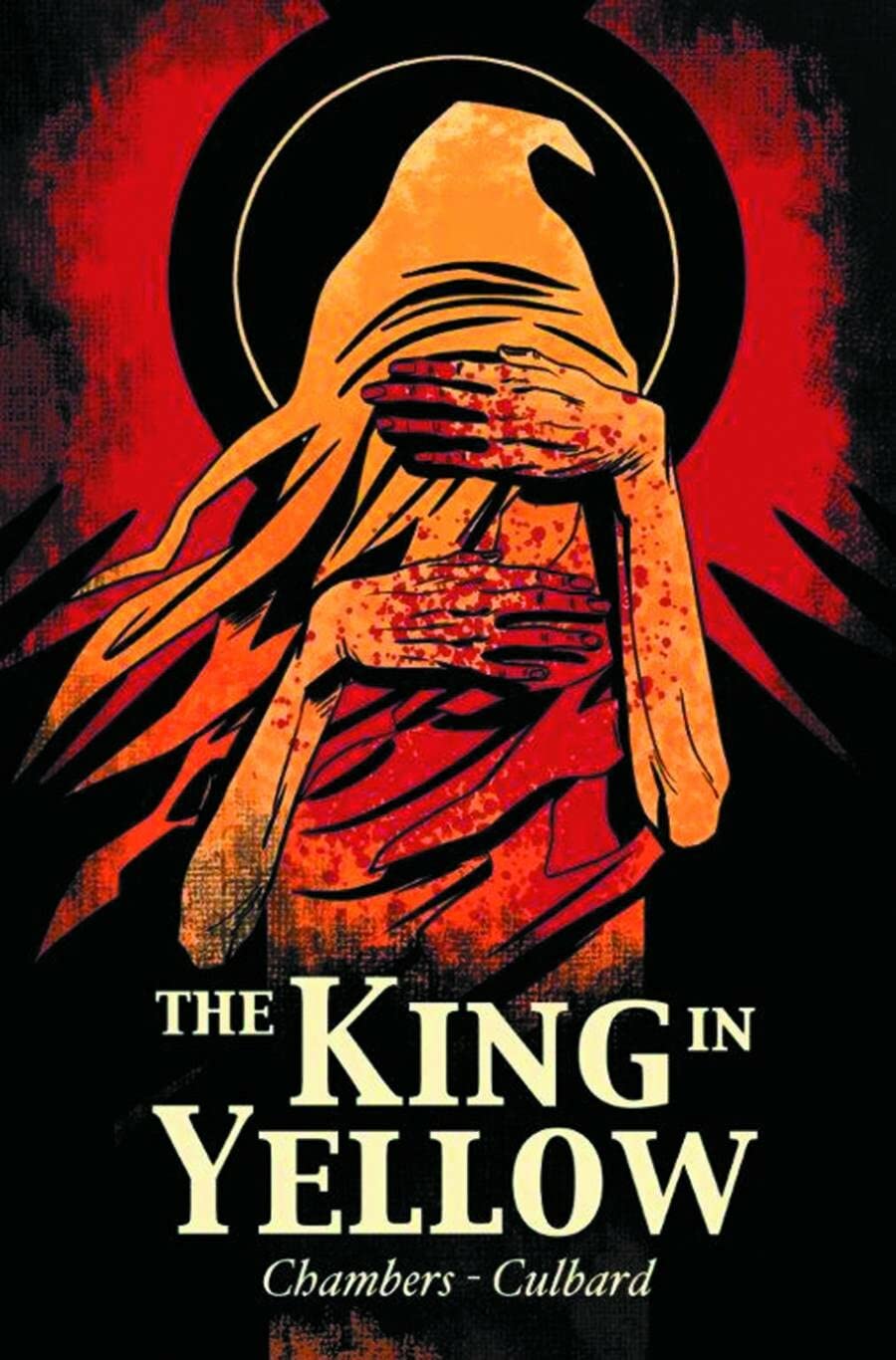
The King in Yellow


The King in Yellow
by INJ Culbard
adapted from the short stories by Robert Chambers
1895, adapted 2015
 
 
The King in Yellow is a graphic novel adaptation of the first four stories in Robert Chambers' 1895 collection of the same name, by British comics artist INJ Culbard.
 
Chambers' stories remain pretty well known among fans of weird fiction, inspiring, among other things, some of the imagery in the first season of True Detective, as well as the indie D&D adventure Carcosa. I know Culbard from his comic Brass Sun, but I gather he has a number of these illustrated adaptations.
 
The four stories each contain characters who read the fictional play The King in Yellow. Supposedly its performance and even script are banned, but it circulates by being passed from reader to reader. The first act is fantastical horror story, and Chambers introduces each story with an epigraph supposedly from Act I. The second act isn't directly described, except that people who start reading it aren't able to stop partway through. They're driven mad, and are compelled to share the script with others. People who've read the play seem to believe that The King in Yellow is a real person (or god), that they serve him, and that his symbol, The Yellow Sign, can be used to identify both fellow believers and the King's commands.
 
In "The Repairer of Reputations," Hildred is a troubled young man who was recently released from an asylum where he was kept due to severe personality changes after falling off a horse and hitting his head. He's convinced that he can be crowned as some sort of royalty, but that first he needs to kill his own cousin (whom he believes is a rival heir). I love Culbard's rendering of Hildred as someone with an overly intense stare, who very clearly unnerves the people around him. Hildred has read the play, and after the violent conclusion of his plan, it's mailed to a friend in Paris.
 
In "The Mask," the sculptor who reads the play develops a chemical that converts living matter into something like white marble. He likens this process to the sculptural equivalent of photography. After preserving a rose and a rabbit, he gets the idea to try his chemical on a person...
 
In "The Yellow Sign," the play next arrives by mail for another artist. He and his life-model girlfriend are both troubled by nightmares, and then both read the play, which makes everything worse.
 
Finally, in "The Court of the Dragon," the young man from the previous story, already mostly out of his mind, is tormented by visions and phantom music.
 
This is a nicely spooky adaptation. "The Repairer of Reputations" remains my favorite. It has elements of science fiction and alternate history, though it's sort of ambiguous if these are 'real' or symptom's of Hildred's madness. As a stand-alone, it's equally ambiguous if the play is special or just something he's fixated on. Its recurrence in the other stories is what makes the play's power over its readers definitively 'real,' as we see life after life ruined by reading it. Honestly, given Hildred's instability, it would be hard to take his beliefs seriously if not for the later stories, which retroactively lend him a bit of credibility.
 
Culbard makes a couple key changes, though I think they're faithful to the spirit of the originals. Most importantly, he treats these as four chapters of a single novella, rather than stand-alone stories. The young man from "The Yellow Sign" appears in both the earlier stories as a friend of the other characters who is alarmed by their fate. It is literally the same copy of the cursed play that is read and passed on each time. The final story (originally the third), is rendered nearly wordlessly, as this character has been driven mad, the pages filled with stylized musical notes and visions of the King.

The idea of the play The King in Yellow is still compelling today, I think. It's a kind of thought experiment, a book that probably should be banned. The idea of a text that, if you read it, changes you in a way that you can't prevent or reverse, remains frightening. It's probably the basis for David Langford's 'basilisk' stories and the contemporary 'cognitohazard' concept - it's a danger that you can only escape by avoiding all contact with it. There's no safe way to study the text without succumbing to it; worse still, you can encounter it entirely by accident simply by doing the thing we all do all day long - read text without knowing what it says already. I think it's that idea that keeps us coming back to Chambers over a century later.

Sunday, September 10, 2023

Trapped on Zarkass


Trapped on Zarkass
by Yann
art by Didier Cassegrain
translated by Dan Christensen
adapted from the novel by Stefan Wul
1958, adapted 2022
 
 
Trapped on Zarkass is a graphic novel adaptation of a 1958 French scifi book by Stefan Wul, who's best known for another of his books that was adapted as the animated film Fantastic Planet. Reading a less-known work by a famous author can sometimes feel like discovering a hidden treasure ... or it can confirm that the better-known work is just better, full stop.
 
Zarkass is set on an alien world, where human colonizers dominate the local population of cockroach people who ride giant caterpillars. Humans believe the natives are stupid, lazy, and docile ... but their leaders might be secretly working with the unknown third-party aliens who have been terrorizing the human settlements with their indestructible triangle-shaped spaceships.
 
Marcel and Louis are human agents posing as butterfly hunters, who are secretly on a mission to inspect and recover debris from the only triangle ship the humans have been able to shoot down. Both are women - Yann and Cassegrain's primary artistic liberty was to gender-swap the original protagonists, and to recast the human colonists as a matriarchy. The triangle ship crashed in the jungle, so this recasting means that Cassegrain draws both women in skimpy hot-weather outfits, with occasional scenes of full nudity. I might be wrong, but I kind of don't think Cassegrain would have drawn male protagonists looking sexy in distress, with their dicks out while shooting guns at drooling alien carnivores, in quite the same way he draws them when they're women.
 
Marcel is a blue-collar type, press-ganged into service straight from prison, and she has an earthy appreciation for roughing it in the jungle, and she swears continuously. Louis is persnickety and proper, and is only doing this so she can try to steal some local medicine for her sick daughter back on Earth. I think this book is supposed to be comedic, with about half the humor coming from the friction between Marcel and Louis, and half coming from toilet humor about the giant caterpillars' shit, farts, and other secretions, all of which are important to the roach people. Their alcohol is fermented from caterpillar shit; the medicine Louis needs is essentially pus. Marcel takes this all in stride and Louis is disgusted by all of it.
 
While these two are in the jungle, the triangle-ship aliens succeed in provoking a full-scale native rebellion against the humans, who rush to evacuate. Louis keeps hallucinating a dead roach-person king, and eventually becomes the king's reincarnation, and the roach's new post-rebellion leader.
 
I'm fairly sure Wul was writing a satire about the First Indochina War, the conflict that preceded what Americans call the Vietnam War, although the scenes of people crowding onto overloaded evacuation shuttles are drawn to look like scenes from the American military's withdrawal from Vietnam. I say satire, but I'm not sure I really understand Wul's point or target, or at least not as interpreted by Yann and Cassegrain.
 
The natives appear, by human standards, to be gullible and unintelligent. They have no empathy for others' suffering, and nearly everything they do seems to be a joke whose punchline is '...and Louis is grossed out by that!' That isn't actually an argument that they don't deserve political freedom, but they do seem like exaggerated versions of the colonial excuse that the people being colonized are childlike and uncivilized and need the education and firm discipline the colonizers will bring. And they are easily manipulated, first by the humans, then by the triangle aliens, and finally by Louis-as-king who brokers peace with the humans again.
 
The human matriarchy is portrayed as being almost completely amoral, with every official we see being crass, ruthless, and needlessly abusive toward her subordinates. And Marcel's personality most consists of her using racial slurs against the roach people, being joyously unfazed by alien grossness, and exclaiming a steady stream of gender-swapped profanity, complaining that a long caterpillar ride hurt her vag, for example, where a man would presumably complain about the pain in his ass.
 
So the overall effect seems to be less of a critique of colonialism, and more a scenario where everyone is awful, but where Louis merging with the soul of the king and ruling the natives is shown as justified and almost universally beneficial. The triangle aliens don't benefit, but their exploitation of the roach people is depicted as unambiguously wrong, while the humans' self-serving justifications for colonial occupation appear to be literally true within the text.
 
The Vietnam War inspired a lot of American scifi authors to try to grapple with the morality of what their country was doing. It seems like it should be easy for the interested reader to find another book that does it better.

Wednesday, June 21, 2023

Giraffes on Horseback Salad


Giraffes on Horseback Salad
The Strangest Movie Never Made
by Josh Frank and Time Heidecker
art by Manuela Pertega
adapted from the screenplay by Salvador Dali
1937, adapted 2019
 
 
Giraffes on Horseback Salad is a graphic novel that adapts a proposal for a movie that was never produced - a film written by Salvador Dali, starring the Marx Brothers. Well, I say 'written,' but what Dali actually produced was 84 pages of handwritten notes and sketches and a 14 page proposal to MGM. There was no completed script. So this was not a simple or straightforward adaptation, and includes a lot of creative input from everyone involved.
 
Josh Frank has apparently made a career of adapting famous unfinished projects, with this just his most recent. Frank read up on Dali during the years he lived abroad because of the Spanish Civil War. He met with Harpo Marx's son -  Harpo and Dali were friends, apparently. And he got copies of the notes and proposal from a Dali archive. Frank brought in comedian Tim Heidecker to help write the Marx Brothers' banter, since Dali's notes just indicated places they should be allowed to improvise. Manuela Pertega is a Spanish cartoonist, included for her interest in surrealist art.
 
So, the first 40 pages of the book are front matter, explaining all that. A bit like the documentary Jodorowsky's Dune, really. And then the last 200 pages are the graphic novel itself, which is styled and structured to look like an adaptation of a finished movie, even though the only place the 'movie' exists is as this comic.
 
Jimmy, played by Harpo Marx, is a hardworking and cleancut young businessman. He has an ambitious but loveless fiancee, and he's really going places on Wall Street. Then one night while they're out to dinner, Jimmy catches a glimpse of the mysterious Surrealist Woman, who is announced and attended by Groucho and Chico. (The fiancee has a sidepiece boyfriend, who might be Zeppo, but I'm not certain?) Jimmy is instantly smitten, and suddenly discovers he can play the harp...
 
The Surrealist Woman has the supernatural power to manifest imagery from her dreams into the real world. In controlled spaces like a restaurant, she can pass it off as an elaborate and expensive publicity stunt. Jimmy dumps his fiancee, meets up with the Surrealist Woman at her next party, and the two of them declare their love for each other. Her happiness unleashes unrestrained chaos on the world.
 
The fiancee helps lead an effort to arrest the Surrealist Woman, which succeeds, and she's put on trial, with Groucho acting as her defense and Chico the prosecution. Jimmy sneaks in 'in disguise' looking properly like Harpo, and they escape into the streets of New York, where they fight a war between the forces of bourgeois order and surreal chaos, including flaming green giraffes running through the city.
Jimmy and the Surreal Woman briefly retire to a house in the suburbs where she manifests his dream of comfort and safety, but then they both agree this is too boring, and the commit to living dangerously and artistically. 
 
Frank's commentary in the front matter suggests that Jimmy was intended to be a semi-autobiographical character. Dali came from a respectable family, and perhaps especially while he was abroad during the Civil War, may have questioned whether his flamboyant lifestyle and persona were really the right choice.
 
Pertega's art really captures the prevailing balance of power at any given moment between conventional order (shown in linear panels in grayscale,) and surrealism (shown in color in irregular, cross-cutting panels are lack an obvious chronological order.) The manifestations of the Surrealist Woman's emotions into reality reminds me of a similar effect used in the Shade, the Changing Girl comics.

Saturday, March 11, 2023

Shirley Jackson's "The Lottery"


Shirley Jackson's "The Lottery"
The Authorized Graphic Adaptation
by Miles Hyman
adapted from the short story by Shirley Jackson
Hill and Wang
1948, adapted 2016
 
 
Shirley Jackson's "The Lottery" is, as you might guess from the title, a graphic novel adaptation of Shirley Jackson's short story "The Lottery." It was adapted by artist Mikes Hyman, who is Jackson's grandson. 
 
This might be one of the rare cases where it takes longer to read the comic book version than the original (though not by that much) because Hyman slows the pace of his adaptation to build suspense at a few key moments.
 
The art reminds me of the murals that got painted in a lot of city halls as part of the WPA's Federal Arts Program. It's very distinctive, because few if any other comics look like this, and it fits really well with the text, which has always felt like it took place during the Great Depression to me.
 
"The Lottery" is deservedly famous, and caused a bit of a stir when it first came out. On a specific day of the summer, in a small town in New England, the whole town gathers, as they do every year, for the lottery. It's an old tradition. 
 
First, the head of every household draws a slip of paper from the old box. One slip has a black mark. Then, everyone in that house draws again, and one family member is the final person to get the second black mark. What happens is, of course, also a very old tradition.

Saturday, December 31, 2022

Black Water Lilies


Black Water Lilies
by Frederick Duval
art by Didier Cassegrain
translated by Edward Gauvin
adapted from the novel by Michel Bussi
Magnetic Press
2011, adapted 2022
 
 
Black Water Lilies is a graphic novel retelling of a 2011 novel by the same name. Bussi wrote the original, Duval adapted the text, Cassegrain supplied the beautiful watercolor imagery that makes the whole book look like a Monet painting come to life.
 
Black Water Lilies is also a murder mystery that takes place in Giverny, the village where Monet settled, built his gardens, and did a lot of his most famous paintings. The story focuses on an 11 year-old girl, the beautiful village school teacher who instructs the 11 year-olds, and an old woman in black, who narrates the story. A man has been killed inside the famous gardens, and police from Paris are called in to investigate. The woman in black begins the story by locating it very precisely in time, during an annual Monet festival in 2010, when the gardens are open to the public. She tells us from the start that the story begins with one murder and will end with another.
 
The old woman mostly wanders the village and observes. She is newly widowed, and secretly owns the 'Black Water Lilies,' the apocryphal last painting Monet made, all in black, just before he died. I spent nearly the entire book wondering if she was the murderer, and if so, why?
 
The little girl, Fannette, has a talent for painting and hopes to win an annual worldwide children's art contest, so she can go study abroad. Several of her classmates have crushes on her - one she loves back, another grows increasingly jealous. She also has a secret tutor, an old man who helps her improve her technique, until he is murdered too, and his body vanishes, with Fannette seemingly the only one who knows.
 
The teacher, Stephanie, has a jealous husband who is suspected of the murder. One of the Paris police officers is obviously smitten with her, which compromises the investigation. But Stephanie loves him back, and wants to leave her husband for him.
 
The dead man was known to have several affairs, and someone sends the police photos of him with other women, including Stephanie. Some of the photos are explicit, others seem benign except for the context. He had a note on his body that seems to imply he secretly had an 11-year old child with one of his mistresses. So who is the child, and who is the mother? Is this why he was killed? The dead man also dreamed of owning an original Monet, something he could never afford at a fair price, so could that be the reason instead?
 
For two weeks, the police bumble around without fully solving anything. In the end, the old woman explains who committed the murders, and in doing so, reveals several truths that lingered just out of focus at the periphery of the story the entire time. 
 
The whole book was excitingly tense, both because you knew another death was coming, and even moreso because you cared what would happen to the girl, the teacher, and the crone. The ending is incredibly well-executed and makes the entire book better in retrospect. I immediately began flipping back through to consider things anew. I highly recommend this one! It was an excellent choice for the last book I'll finish this year.