Showing posts with label games. Show all posts

Thursday, August 6, 2026

DIE 4


DIE 4
Bleed

by Kieron Gillen
art by Stephanie Hans
2021 
 
 
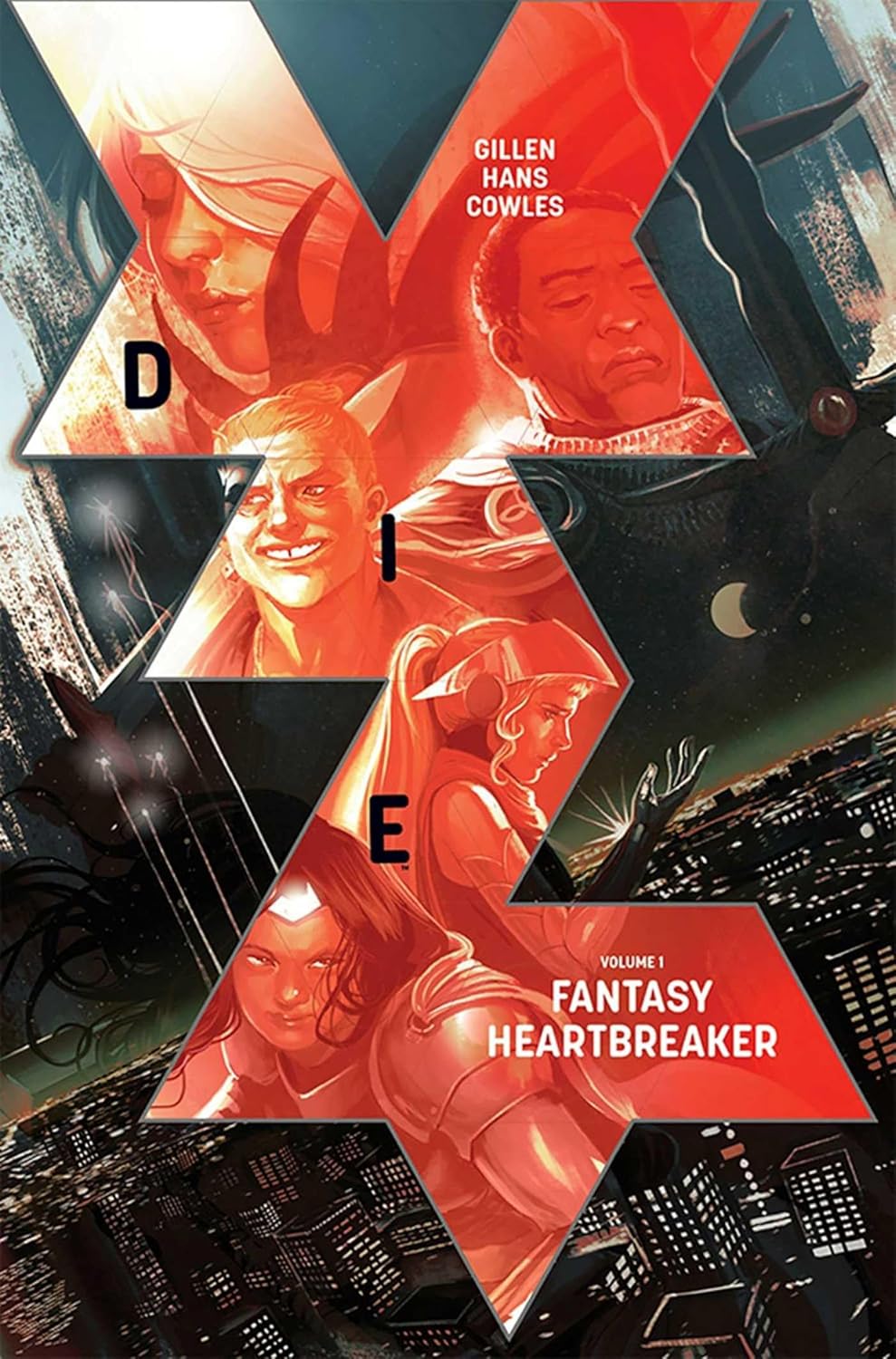
From the start, I've found myself drawn to the high-concept worldbuilding of Kieron Gillen and Stephanie Hans' comic series DIE, but (especially after the first volume) I've been less impressed by the plot and storytelling going on there. The comic is at its best when introducing a character or idea and letting admire all the allusions and creativity on display in each one, but then less successful at setting them in motion. Which is especially a problem here in the final volume, "Bleed", because there's little left to introduce, and a lot of plot left to resolve.
 
As an example, consider the Fair. These are Die's equivalent of fairies, but they're also robots. They act fairly in the sense that they'll hear any request, and they have a 50 percent chance of granting it, so they are fair like a coin toss. The two faces of the coin are 0 for no and 1 for yes, because the binary outcome is like a computer bit, which is why they're robots as well as fairies. Also, the way that you meet them is by going to the Fair, a kind of traveling festival they run. 
 
Merging multiple inspirations like that and layering multiple meanings into one thing is kind of impressive ... but then in this volume, all we see of the Fair are their smashed bodies, because the flew to the center of the world to take part in a climactic confrontation that happened entirely off camera. We just see the ruins of the aftermath, like HG Wells's smashed time machine from whatever his role was in the decisive last battle, which Gillen and Hans decided not to show us any of.
 
This is what I mean when I say that the ideas of the comic are very careful constructed, while the story itself is ultimately pretty disappointing.
 
In the 1990, a group of teenagers found some magic dice that transported them to the fantasy world of Die. There, they each had a fantastic persona and access to powerful magical abilities. They spent a couple years trapped there, battling the evil Grandmaster, before defeating him and performing the ritual to return to Earth. But in the last moment, the Grandmaster grabbed Solomon, and so only five of the six friends made it home. Since they had vanished without a trace for two years, it was a big deal when they came back, but they were magically prevented from saying anything about what had happened.
 
Then, a couple decades later, when the survivors were all in their early 40s and facing the typical (stereotypical?) problems of midlife, they were transported back to the world of Die and thrust back into the old game, only with their former friend Solomon acting as the Grandmaster this time. They defeated Sol, but then couldn't actually agree about returning home, some because they wanted to avoid an impending divorce or a cancer diagnosis, others because they felt guilty about destroying a whole city to defeat their former friend. Basically whenever someone changed their mind to return, someone else changed it the other way to stay, so that collectively they just seemed to be dithering indecisively.
 
While the heroes spent the next two volumes of the comic squabbling and sabotaging each other, we got a bit of a tour of Die. It's a planet shaped like a d20, and each face is the realm of a different Master, an echo of a real person who had some idea that contributed to the history of roleplaying. There's Eternal Prussia, based on the original German military war game, Kriegspiel. There's Little England, a mash-up of Tolkein's Lord of the Rings and HG Wells's Little Wars, a war game for hobbyists to play on their living room floor. Eternal Prussia and Little England are locked in an unending war that resembles WWI. There's Angria, based on the Bronte siblings' childhood game of make-believe, a site of political intrigue, and the place our protagonists did most of their bickering. In this most recent volume, we also got to see an ocean face based on HP Lovecraft's fiction, which holds the stairway to the center of the planet. 
 
Near the end of the third volume, we got a call to action that seemed to set up an exciting conclusion. We learned that between the group's two visits, Sol had been busy working on behalf of the planet Die itself to send inspirations backward in time to ensure its creation. Supposedly Sol made the toy soldiers that inspired the Brontes' for example, and sent them to them so that they'd write their stories, so that Angria would be here waiting for teen Sol in the 80s. The friends learned that if Sol succeeded in making the dice that had transported them as teens, and sent them to himself, then the time paradox would resolve, Die would fully merge with Earth, and everyone would be trapped in a fantasy realm. To prevent this, the friends recruited the Fair, rallied Wells and the armies of Little England, plotted to entangle the plotters and schemers of Angria ... and then, as I mentioned, in this volume, Gillen and Hans decided not to show us any of that.
 
Instead, we watch the six sad adults mope down the stairs to the center of the world where they don't stop anything, but also nothing bad happens. Die, suddenly now personified as a guy with a d20 for a head, explains that they're too late, he's already successfully closed the time loop to ensure his own existence, and now that they've witnessed it, he can send them home. In explaining all the steps, he even claims to have caused WWI, which would otherwise not have happened, purely so that Tolkein would be inspired to write The Hobbit, which horrifies the friends, but they're too late to do anything about it. There's no mention of the planets merging; it seems less like anyone saved the day and more like the authors forgot what the consequences were supposed to be. When they get home, it's 2020, and they arrive in the middle of a global pandemic with no idea of what they've missed.
 
Along the way down the stairs, we finally get a bit of resolution about Ash's up-to-now unspoken feelings about gender. I felt let down about this too. On Earth, Dominic is a man and seems to be fine with that; on Die she is a woman named Ash and seems to be fine with that too. As they descend, we're told that the Grandmaster only caught Sol because Ash paused during the ceremony because she didn't really want to go back to Earth. We also meet the giant fiery spirit of Ash's femininity, who blocks the way unless Ash will agree to merge with her. 
 
Ash says that on Earth, Dominic thought about being a woman at least once a day, not that he minded living as a man, just that it was a thought he had every single day. And given the chance to have a woman's body, Ash didn't want to leave Die then and doesn't want to leave now. And she merged with the spirit of herself (?) which supposedly displaced Dominic entirely. And what this means, the characters tell each other, is that Ash is gender fluid. Dominic definitely wasn't a closeted trans woman! And he'll be fine having a man's body and social identity again as soon as they all leave, even though right now Ash can't bear to give hers up. Yes, the characters repeat, this isn't being trans, its gender fluidity. 
 
This development adds DIE to my list of disappointing works where a character is seemingly portrayed as being a trans woman, only for late-in-the-game dialogue to reveal that, oh no, they're definitely not that, they certainly couldn't be that, they're just like, really sensitive and in touch with their feminine side, or maybe their gender cannot be labeled in any way at all. 
 
I would be interested in seeing more authentic portrayals of nonbinary characters in fiction; I am not interested in seeing yet more characters who are written in every way like they're trans only to make a surprise announcement of some sort of nonbinary identity at the last minute instead. I'm not interested in listening to people who seem to think that saying you're bisexual or gender nonbinary is enlightened and expansive (so long as you publicly live a conventional hetero life), but that being gay or trans is small-minded and unworthy. It's not fair to the people who are treated like their identity is unspeakable; it's also not fair to the people who are treated like the name of their identity is a cudgel to beat the unworthy, while the actual experience of what they feel or how they live is never shown.
 
But then, many things about DIE disappointed me. The first volume seemed promising, but overall, the comic has seemed more like a neat idea than like a good story, and nearly every time I've felt interested in some aspect of it, character or plot or whatever, that aspect has been ignominiously dropped or anticlimactically abandoned.

Thursday, April 23, 2026

Twisty Little Passages


Twisty Little Passages 
An Approach to Interactive Fiction
by Nick Montfort
2003 
 
 
Twisty Little Passages is an academic history of interactive fiction from the late 1970s to the early 2000s. The title is a pun, referring to the passages of text that make up interactive fiction and the maze-like underground passages that the fiction frequently describes. Interactive fiction is abbreviated IF in the same way that roleplaying games are abbreviated RPGs. Nick Monfort explains what interactive fiction is, gives a history of its origins and rise to commercial success in the 1980s, and discusses how independent implementers - the people who write interactive fiction - took over the form once again in the 90s when it was no longer especially commercially successful.
 
What we today call interactive fiction was originally known as text-based adventure games. The name change reflects a certain amount of legitimacy seeking by its creators, but it also reflects the growing complexity and maturity of their literary efforts. The basis of interactive fiction is a kind of turn-taking between text displayed by the computer and text entered by the interactor - the reader or player of the fiction. The simplest commands are just two words, things like 'go north' or 'take key'. Unlike the Choose Your Own Adventure books, where the reader can only choose from 2-3 options at each decision point, interactive fiction is more open-ended. You can try more things, especially moving and interacting with objects, though you're still limited by the parser, the part of the software that interprets and responds to commands. The setting of the fiction, the setting the interactor moves their character through is called its world.
 
When I was a kid, my family had a Commodore 64, and among our game collection we had some text-based adventure games of the type Montfort is describing, and some kid-friendly graphic adventure games that had a single still image for each location in addition to the descriptive text, and sometimes had an on-screen menu of command words to choose from. (When there was no menu, I recall sometimes being frustrated by the parser's limited vocabulary, like if it only knew 'go' but not 'walk', or 'take' but not 'pick up'.) Monfort focuses on the purely textual games. Commercially, I suspect there was a 'video killed the radio star' situation where graphics and point-and-click interfaces supplanted text, even as the basic type of game remained the same. I think Myst is a lot like some of the games in this book, for example, except that it's puzzles and world are all image-based rather than text-based.
 
Monfort identifies several lenses for understanding interactive fiction. They can be understood as literature, as games, as procedures for producing narratives (like the I Ching or some of the experimental writing of the Ouilipo authors), as software, and as riddles. He spends a whole chapter very early on belaboring the comparison to riddles, which nearly exhausted my patience, but I found each of the other lenses more useful.
 
Probably the first interactive fiction was Adventure (sometimes called Colossal Cave). It inspired a number of similar adventure games, including Zork (sometimes called Dungeon), which in turn inspired the first flowering of commercially successful interactive fiction. Adventure and Zork both take place in cave systems and involve exploration; Zork also incorporates a mix of fantasy and technology. Both have maze-like areas and other navigational challenges, and puzzles that require using items found in the caves. They both came out a few years after Dungeons & Dragons, and were somewhat influenced by it (the back-and-forth conversation between interactor and parser resembles the dialogue between player and Dungeon Master, for example), but they're definitely not direct copies. These early games were written on mainframe computers, accessed on terminals, and shared over the internet at a time when you mostly had to be a university or on a military base to access it. 
 
The creators of Zork were based at MIT, and they formed the company Infocom to sell copies of their games to the owners of then-new personal computers. Montfort describes several. The two that interested me most are kind of about the relationship between people and technology, and both add an extra layer of metafictional distance between the player and the game. In Suspended, the interactor takes on the role of a human in a cryogenic hibernation chamber, who must in turn telepathically command several robots to explore the moon base and repair problems. Each robot has different senses and tools, so each describes the rooms differently and contribute in different ways to puzzle-solving. You can even tell a robot to break your cryo-chamber, killing you instantly! 
 
In A Mind Forever Voyaging, you take on the role of a sentient computer who's been assigned to simulate a small town and itself as a resident of the town, so the main character is essentially playing its own interactive fiction. The simulation is repeated several times, showing the increasingly dire effects of right-wing policies on the townspeople over several decades. According to Montfort, this setup humanizes the computer, who can sometimes help simulated people in the game-within-the-game, but is helpless to convince its programmers not to go forward with the policy changes.
 
Montfort gives us a quicker tour of the other interactive fiction companies of the 80s. In Britain, they seem to have been especially fond of literary adaptations, including Gateway and Rendezvous with Rama, getting Douglas Adams to help adapt The Hitchhiker's Guide to the Galaxy, and bringing in Daniel Pinsky and Thomas Disch to work with programmers on unique new works. 
 
By the 1990s, these companies could no longer really profitably sell text adventures to mass audiences; they either moved on to graphical adventure games or closed. But since then, Montfort notes that a dedicated audience of implementers and interactors continue to make and play interactive fiction purely for love of the genre. Monfort compares this to poetry, which is too niche for anyone to make a living writing poetry alone, but which also continues to have enough interest from both writers and readers to persist as a living scene and medium. I'm a little curious about what's new in interactive fiction since Montfort wrote this ... and also a bit interested in revisiting some of the text and graphic adventure games I played as a kid. 

Saturday, February 7, 2026

DIE 3


DIE 3
The Great Game
by Kiren Gillen
art by Stephanie Hans
2020 
 
 
In the first volume of DIE, six teenagers in England in 1990 found six magic dice, and disappeared into the fantasy world of Die, an Earth-sized planet shaped like an icosahedron, a d20. They were trapped their for years, living out fantasy adventures in their roles as the mind-controlling Dictator, the lucky Fool, the emotion-powered Grief Knight, the cyberpunk Neo, the God Binder, who trades favors with supernatural entities, and the Master, who runs the game. Eventually the group learned a magic ritual that would let them leave and return home, but when they left, Solomon, their friend who'd first found the dice and acted as the Master, was seized by the evil Grandmaster who ruled the whole world of Die.
 
25 years after they returned, the now middle-aged friends got pulled back into Die. In the intervening years, Solomon had killed the old Grandmaster and become the new one. He wanted the game to resume, and the others couldn't leave without changing his mind or killing him. He holed up inside his fortress in Glass Town, protected by the armies of Little England and besieged by the armies of Eternal Prussia. The group has long since decided that although strange, the planet Die is real, and its inhabitants have the same moral worth as people living on Earth. Despite this, they also agreed to help Eternal Prussia break the siege and crack the giant bell jar protecting Glass Town so they could kill Sol and go home. The plan succeeded, but then not everyone was ready to leave yet...
 
So then in volume 2, the group split, then recombined, and split again. Initially, two members wanted to stay for awhile to avoid their problems back on Earth, while the others wanted to return immediately. With time to settle in though, everyone starts to feel guilty about what they did to Glass Town and worried about what Eternal Prussia might be doing in there. When they split up again, it's basically a disagreement about tactics instead of goals.
 
Now in volume 3, Dictator Ash and God Binder Izzy are co-ruling the nation of Angria, which is based on the fantasy world the Bronte siblings created together as children. The WWI-era hobbit army of Little England arrives at Angria's capital to demand Ash's surrender for her role in the fall of Glass Town. She arranges to meet with the Master of Little England, who turns out to be HG Wells. He explains that the German inventor of the original military wargame, Kriegspiel was drawn to Die, and his game formed the basis of Eternal Prussia. Wells blamed Kriegspiel for emboldening Germany's military, and wrote his own Little Wars game to try to discourage actual warfare. Ash disillusions him by revealing that WWI happened anyway, and Wells sets off in his time machine to do ... something. But the meeting succeeds in forging an alliance between Little England and Angria.
 
The others are all headed for Glass Town directly. Along the way, they meet a Fallen version of Neo Angela's daughter. The Fallen are like zombie orcs. When Sol became one after they killed him, they realized all the Fallen are former players who died on Die. They wonder how any Fallen could've already been there in 1990, if they were really the first players to arrive. (HG Wells and Charlotte Bronte are Masters, not players.) They also wonder how Angela's daughter could be there, and why she's years older than when Angela left. 
 
They learn from some helpful dwarves that Sol actually created the 12 toy soldiers that inspired the Brontes to write their Angria stories. Eventually the meet some Fair (robot elves from the future) who reveal that Die itself is from the future, but that it draws in people from the past to help ensure its own existence. It sent the toy soldiers back to recruit the Brontes, and the magic dice back to recruit Ash, Angela, and the others. What Eternal Prussia is making in Glass Town now, almost 30 years after their first visit, are the dice that will bring them here. If the dice are made and sent, the Die will merge with Earth in 2020. So Angela's daughter, and the other Fallen, are like the ghosts of people who haven't died yet, but will. Or they could all be saved, if the group can interrupt the creation of the magic dice...
 
Because Gillen is giving us a close-up view of these characters, we really only see three faces of Die - Angria, Little England, and Eternal Prussia, plus the Grandmaster's Realm on face 20. I can't help but wonder what would be on the other sixteen sides! 
 
Planet Die is an interesting villain. Like Roko's Basilisk, it's a malign intelligence from the future that's manipulating the past in order to ensure its own creation. Normally I wouldn't think if a planet as being a villain, but several characters who would know have suggested that Die either has or is being controlled by some sort of evil mind. I'm not totally sure how the Fair fit into this; maybe they're from further in the future, after Die merges with Earth. Ordinarily, in comics, I'd expect the good guys to win, but this is a dark enough fantasy that a downer ending seems possible. 

Monday, July 28, 2025

DIE 2


DIE 2
Split the Party
by Kieron Gillen
art by Stephanie Hans
2020
 
  
In the first volume of DIE, we learned that on Dominic's 16th birthday, he and five of his friends gathered to play a bespoke roleplaying game. They vanished from the Earth for months, and when they came back, they were unable to speak about anything that happened there, and game master Solomon remained behind. Then, a couple decades later, as they were all staring down the disappointments of their mid-30s, they got pulled back to the game world, back to the 20-sided planet Die. 
 
When they returned to Die, each got back the supernatural powers they had the first time. Also, Dominic, who seemed happy enough to be a man on Earth, became a woman named Ash. Going back again opened up a lot of old wounds and traumas, and the group couldn't leave until everyone agreed. Ultimately, they killed Sol, but then the group fractured, with three wanting to leave, and two wanting to stay behind.
 
In volume 2, Split the Party, we return after more weeks or months have passed, and both sides are basically hopeless. Ash the Dictator, who can compel people to do things; her sister Angela, the fairy-powered cyberpunk Neo; and Matt the Grief Knight, whose powers are fueled by his own and others' sadness, are trapped in the besieged remains of Glass Town. Izzy the Godbinder, who can compel spirits to do do favors for her on the promise she'll do them a favor in return in the future, and Chuck the Fool, who can be supernaturally lucky, so long as he remains over-confident and non-self-reflective, have been transported to the far side of the planet. Everyone is starving and desperate at the start of the volume.
 
Die seems to be made up of the remains of the games others have played there before. Glass Town, and the countries Angria and Gondal, were all invented collectively by the Brontes; the conquering army from Eternal Prussia seems like it came from the war games HG Wells used to play on the living room floor with Robert Louis Stevenson. My recognizing this isn't a spoiler, but neither is it something Gillon necessarily expects his audience to already know. The characters certainly don't. An explanation of the allusions is part of the plot. Zamorna, who is as fiendish as he is handsome, is another Bronte creation; he eventually describes himself as a ravisher of 17 year-old girls, dreamed up by a 17 year-old girl who wanted to be ravished. Gillen makes him literally a vampire.
 
The last time the group was on Die, they initially treated is as just a game, the place itself and its inhabitants as unreal. They acted as though their actions had no consequences, as though they were the only people present who could be hurt or who had lives that mattered. They were also, after an unspecified period of just having fun, desperate to figure out how to escape and return home. Eventually they came to accept that Die was real, magical but real, that the people who lived there were real. We don't really know what they did before reaching that point, but we know they regret a lot of it, now.
 
And they regret all the chaos Sol caused, and that their only plan to defeat Sol involved allowing Prussia to wreck Glass Town. Sol, though dead, persists as one of the Fallen, the zombie-orcs that the group used to just think of as generic monsters to kill.
 
Ash, Angela, Matt, and their prisoner Sol go to Angria, where they are greeted by Ash's son, Augustus, who is a member of the Ruling Party here. It seems that as teenagers, Izzy dated Zamorna, then Ash dated Zamorna and got pregnant, and Izzy got a goddess to agree to take over the pregnancy when they all returned to Earth. Izzy and Zamorna arrive not long after Ash, (Chuck is off sleeping with elf queens instead, apparently,) and Izzy confesses to the group's role in the conquest of Glass Town, which gets them all locked in bell jars in prison.
 
While they're locked up, their jailer is the ghost or remnant of Charlotte Bronte, who briefly tells the story of how she and her siblings made up their parts of Die. Allegiances shift, and Ash agrees to help Izzy save the world before they leave again, which involves a complicated plan to temporarily amplify her Dictator's powers to make herself the queen of Angria and place Zamorna under her thrall. We'll have to wait to see what she'll do!
 
Meanwhile Chuck shows up, luckily at just the right time to rescue Matt and Angela, leaving the zombie of Sol in prison. They have a different plan to save the world, so they're off to the races too.
 
Gillen's use of so many literary characters and setting components here reminds me of The League of Extraordinary Gentlemen or Fables, though I suspect the gaming history he's drawing on is much less familiar to most people than the literary heroes and fairy tale figures from those series. 
 
Portal fantasies where you change when you pass through the portal (and I guess magical girl series where you transform to activate your powers) have the potential to include magical gender changes, but I think Gillen has done more with that idea than I've seen before. My one complaint is that Ash is so reserved and taciturn that we hardly know how she feels, or how Dominic felt about briefly becoming a girl and then turning back into a boy all those years ago. Dominic was bi, and maybe the experience helped him accept his attraction to men? But in neither body does Dominic or Ash appear to experience any kind of gender dysphoria. 
 
We get one page of backstory about her relationship with Zamorna, how it intersected with her fraught friendship with Izzy, and what happened to her pregnancy. The emotion is implied amidst a spare recitation of facts, without the benefit an actual voice to lend inflection to the words. You know she's not happy, that her lack of affect is covering up some kind of pain, but all we see is the surface of the black box. We can only guess what's inside it. Maybe there's more coming, but I can't help but wish that Ash was either more expressive or that she had a foil, another character who experienced the same things but reacted differently, so we could discern more about how she felt by contrast.

Friday, July 18, 2025

Chrono Trigger


Chrono Trigger
by Michael Williams
2014
 
 
Michael Williams' Chrono Trigger is the Boss Fight Books book about the Super Nintendo game Chrono Trigger. I previously read BFB's Spelunky and Earthbound books. Spelunky was pretty great, but it was also written by the game's designer, and so had insight into the creative process that will simply never be available in a book written by anyone else. Earthbound disappointed me because the author paired a walkthrough of the game with a roughly equal amount of narrative about his own life, which was not what I'd hoped for.
 
Chrono Trigger has a much better balance, I think. Williams describes the basic plot, the characters, and a few key moments, in the early chapters, then spends the rest of the book on actual criticism. He looks at the portrayal of gender, race, and sexuality in the game. He talks about the portrayal of social institutions like government, law, and the economy. He actually gets brief interviews with both the original translator who wrote the first English localization, and the one who retranslated the game for a rerelease. He even explores a bit the role of time travel in the game's narrative.
 
Williams does discuss his life a little bit, what it was like to first play Chrono Trigger in the 90s, and he mentions his time as an English teacher in Japan, but like, his reasons for doing so are obvious and help to advance his discussion of the topic at hand. He talks about himself about as much as I do in these reviews; he definitely does not put a whole memoir's worth of life stories into his video game review.
 
Chrono Trigger the game is one of the most highly regarded Japanese rpgs of the 16-bit era, with colorful pixel art, and a plot and cast that ranges across time to include a cave woman, a cursed medieval knight who looks like a frog, a robot from the future, all trying to save their world from the apocalyptic Lavos, who crashed into the planet in the distant past, and who will erupt to fly off to another world in their year 1999, wiping out almost all life in the process. Players travel back and forth in time to assemble their party, face off against Lavos, definitely lose their first battle against the living embodiment of mass extinction, then continue exploring the world at different times until they're finally ready to fight Lavos again.
 
I think Williams's work here probably represents a pretty good baseline of what one should reasonably be able to expect from the whole 33⅓, Pop Classics, Boss Fight Books format. There are a few more of these books that I kind of feel interested in, but I've also realized I'm more interested in histories of how things were made more than I am in commentaries about them. Williams provides a blend of both. But I may have been spoiled by the wealth of insider knowledge in Spelunky.

Monday, March 24, 2025

DIE 1


DIE 1
Fantasy Heartbreaker 
by Kieron Gillen
art by Stephanie Hans
2019 
 
 
Before Tolkein, one of the most popular formats for fantasy stories involved someone from the real world traveling somehow to another, magical world. Think of Neverland or Oz or Wonderland. These kinds of stories are sometimes called portal fantasies, if the way you get to the fantasy world is by dying, and the world operates according to the rules and logic of video games (and you're writing in Japanese), you might call it isekai. Outside of isekais, stories where someone travels to a fantasy world that explicitly exists inside a game are rarer - the main examples that come to mind are Jumanji and the Dungeons & Dragons Saturday morning cartoon series.
 
That's also the premise of the DIE comic book series. If author Kieron Gillen is referencing one thing in particular, it's probably the D&D cartoon. Gillen's characters are roleplayers, and they initially get pulled into the magic world of Die because they're looking for something cooler, more indie, more adult than D&D the game, which they've played before. At the start of the game, one weekend night in high school in England in the early 1990s, six friends start their new game and vanish from the Earth. A couple years later, five of them reappear, unable to talk about what happened.
 
And then, 25 years after that, when they're all in their early 40s, they get pulled back to Die again. Their lost friend Solomon has defeated the old Grandmaster to become the new one, and as the new GM, he really wants his friends to come back and play in the fantasy world. They don't want to stay, but they can only leave if everyone in the party agrees, so they'll either have to change Sol's mind... or kill him.
 
Fantasy Heartbreaker is set in the present with only a little dialogue, and no flashbacks, revealing what happened the first time the friends went to Die. We find out only a little. The old Grandmaster wanted them to tell more people on Earth about Die and recruit them to come there, which is why they used magic to prevent themselves from talking about it. And Sol got trapped by accident, plucked out of the circle when he joined the others in wishing to return home.
 
We don't exactly learn where Die came from or how it works, but like Limbo in Inception, it seems to be built up by accretion, layered with all the dreams of those who've visited before, but shaped most directly by its current occupants. It's currently shaped like an icosahedron, a 20-sided dice. We're told that its earliest manifestation was a realm of pure wargaming math, implied to be HG Wells's Little Wars, now represented as the endless Great War between Eternal Prussia and Little England. We also learn that Die hosts Glass Town, Gondal, and Angria, invented by the Bronte siblings as part of a make-believe game, which I read about last year, too. This is a real gamer's comic; I feel lucky to understand the references. (Although if I didn't, I guess this could've been my introduction, the place I first learned of things I wanted to read more about. I'm sure it has been that for others.)
 
Each of the friends plays a character they invented in their teens, possibly on a lark, when they thought they'd be playing for a couple hours, not a couple years, and certainly not again in midlife. As a teen Dominic came up with the femme fatale Ash. Once they can finally talk about it, the others want to understand, because Dominic doesn't seem to experience gender dysphoria in either body, wears men's clothes at home and fancy ballgowns here, seems to prefer dating women on Earth and men on Die. He can't explain to them. As narrator, he tells us it's simply that, by magic, he's a man on Earth and a woman on Die. I wonder if it's really just that simple, or if we'll learn more later?
 
One of the best scenes in this collection comes when Ash is briefly separated from the others and takes refuge in a trench on the front of the endless war. She meets a soldier from Little England, who looks an awful lot like Elijah Wood, part of a group of four from the same home village. He tells his story, which parallels The Lord of the Rings, and then dies, and then Ash meets Tolkein, or at least, Solomon's representation of him, bringing the author's real life into contact with the stories that grew out of those experiences.

Friday, December 6, 2024

Glass Town


Glass Town
The Imaginative World of the Brontes
by Isabel Greenberg
2020
 
 
Glass Town is a graphic novel that presents a lightly fictionalized telling of the life of Charlotte Bronte that centers on the game of make-believe she used to play with her siblings Branwell, Emily, and Anne.
 
The book opens near its ending, with Charlotte visiting the grave site of her recently dead siblings, and being visited by a vision of Charles Wellesley, one of her imaginary characters, the one most like herself in Greenberg's telling. In conversation with Charles, Charlotte remembers her siblings and their make-believe game, and the rest of the book appears as an extended flashback from this 'present day' moment that we return to again at the end.
 
The earliest time we return to is also a funeral. The two eldest Bronte sisters have just died of illness they caught at boarding school. Charlotte is now the oldest, and with Branwell, Emily, and Anne, she starts a game they can play together, imagining the city of Glass Town, on a British-colonized African island called Angria. Greenberg portrays Charlotte as a natural leader, but one who defers to Branwell because she believes that, as the only brother, he ought to be in charge of the girls.
 
Throughout the book, the invented character Charlotte is most interested in is the womanizing poet Zamorna. She clearly loves him, gets jealous of the fictional women she pairs him with, and even changes the narrative to punish them for getting the attention she wants for herself but can't have. Greenberg depicts Charlotte as kind of romantically obsessed with cruel, patriarchal men; she wants someone who can boss her around, but she's so strong-willed that she keeps creating tyrants in an attempt to find someone to rule her. Charlotte seems to try to mold Branwell into this same kind of man, but he crumbles beneath the pressure she puts on him.
 
The siblings build up Glass Town in the stories they write for each other, especially Branwell who wants war and adventure stories, and Charlotte who wants romance and domestic drama. They spend all day every day playing. Eventually Emily and Anne get tired of always getting overrun and invent their own island, Gondal, to tell their own stories their own way, without their older siblings taking over.
 
Eventually, their father sends Charlotte to boarding school again. She and Branwell write each other letters to keep the game going initially, but when he stops writing, Charlotte carries on by herself. Things come to a head when the various ongoing plots in Glass Town come to a climax - overlapping love triangles intersecting with a revolution for African independence - and Charlotte worries that she's becoming unhealthily obsessed. She turns away from her fantasy world, she and her sisters publish their novels, and then all the siblings but Charlotte fall sick and die within a year. This brings us to the 'present' when she has the chance to choose again, to return to her fantasy and get lost in it, or to stay grounded in reality.
 
Greenberg's art is noteworthy. The proportions of the people and the perspective of the buildings resemble's children's art, an impression that's reinforced by the rough linework, which looks more like charcoal than ink. The color scheme of the entire book is autumnal, with reds and pinks, oranges and browns, splashes of yellow and purple, but no blue or green at all. Scenes and characters from Glass Town are in full color, while the living Brontes are monotone. Grey in the present day when Charlotte is in mourning, brown before the game starts, red at the height of the excitement, pink and orange when Charlotte is at school. You really feel that the fantasy world is more lively than reality, both brighter and more saturated with emotion.
 
Greenberg published in 2020, Catherynne Valente write a YA novel about the Brontes a couple years earlier called Glass Town Game. I'm not quite sure why a 200 year-old kids' game made it into the zeitgeist just then, though I'd guess that it helps that Oxford published a collection of the Brontes' Glass Town writings in 2010.
 
Lots of kids play let's pretend, but the Bronte siblings wrote their imaginary world down instead of only describing it verbally to each other. And because they became famous, various people had reasons to collect, preserve, and transcribe these childhood writings, which is why we're able to know or care about them. Whereas if you or I did something similar when we were kids, we would each likely be our own stories' only reader, if we kept them at all, instead of boxing them up in the attic or tossing them in the trash, the usual fate of kids' art, even the stuff that once got displayed on the fridge.
 
I've actually seen essays claiming that the Brontes invented roleplaying games 150 years before Gary Gygax wrote Dungeons & Dragons, or that one or the other of the sisters were the world's first Dungeon Master, but I don't really think that's true, any more so than I think HG Wells invented wargaming when he wrote Little Wars. At most, I think these might be the earliest examples of someone documenting in writing (that survived, and could become part of the historical record) the sort of games that many people played in their heads as kids and young adults, without usually leaving any record behind. And actually, I doubt they're even the earliest, probably just the best known, because these game-players became world famous, and their records got reprinted, rather than being anonymous writings that remain confined to an archive.
 
Which is not to say there's nothing of value here! Glass Town has kind of caught my imagination, and I'll probably read Valente's book about it at some point too. Lots of kids probably had their own make-believe world, but it's not so surprising to think that the future authors of Jane Eyre and Wuthering Heights might've had fantasy worlds that were more interesting than most, just as Wells and his opponent Robert Lewis Stevenson probably described their battles between toy soldiers more entertainingly than your average wargamer.

Thursday, September 12, 2024

EarthBound

 
EarthBound
by Ken Baumann
2014 
 
 
When I was a kid, in the 90s, I had a Super Nintendo, and for awhile, a subscription to Nintendo Power magazine. Games had basically the same price back then that they do today, usually $50 new, which is sort of incredible when you consider how much inflation has happened since then, and the general purchasing power of 1990s dollars. Even more incredible, a lot of the SNES games I owned, I got by saving up my allowance, $5 a week, for like 2½ months per game. Because of Nintendo Power, there were a lot of games I knew about and was fascinated by that I never had the opportunity to purchase. One of those was the game EarthBound, a weirdly postmodern rpg about modern American kids who awaken psychic powers, and travel the country saving it from aliens.
 
EarthBound the book is the first in the Boss Fight Books series, and the author, Ken Baumann, is the graphic designer for the whole series. I read another of these last year, for the game Spelunky, that was written by the game's creator, Derek Yu. The Spelunky book was excellent, combining insight about the game and the decisions that went into making it with biographical details about was going on in Yu's life at the time, and how that impacted the game too. EarthBound also blends writing about the game with the author's memoir, but the problem here is that Baumann isn't the game's designer, he's just some guy.
 
Technically, Ken Baumann is a very minor celebrity. He was an actor on the show The Secret Life of the American Teenager, and when the show ended, he helped found this book series, and created Sator Press, which has since been acquired as an imprint of my favorite Ohio indie press, Two Dollar Radio. In his early 20s, he had a major health scare that almost killed him. His life story is moderately interesting, moreso than mine. But with respect to EarthBound the game, he's just some guy, and all the pages he spends talking about his biography are pages he doesn't spend talking about the game, its influences, its cultural impact, etc.
 
Some of it seems relevant! Baumann is about a decade younger than me, a Young Millennial instead of an Old Millennial, but he was also a 90s kid, and he did buy a copy of EarthBound and play it back then. He bought it again and played it again when, after about 20 years out of circulation, Nintendo re-released EarthBound as a downloadable game for the WiiU, which gave the game a new and much larger audience, including a lot of people like me and Baumann, who remembered our childhood fascination with it. So the parts about Baumann's life when he first got the game do help to inform his reactions to it, especially things like his engagement with things like horror movies and 90s gross-out humor that were part of the same cultural milieu that gave rise to EarthBound. But a lot of this felt like Baumann used the existence of the book as an opportunity to write about himself in a way that only occasionally contributed to the ostensible purpose of the project.
 
EarthBound is a game about kids on a journey. The hero, Ness, discovers he has psychic powers the same night a meteor crash lands in his town, and aliens kidnap some of his neighbors. Ness uses baseball bats and yo-yos as weapons. He stays in hotels, calling home when he needs money, or feels lonely or homesick. He joins up with a psychic girl who he rescues after she was kidnapped for her powers, and later with a child prodigy and a young Tibetian monk-in-training. The mechanics of the game are similar to the Final Fantasy series, but the visuals are a distorted 1950s Americana (50s revival was an important element of 80s culture), and the style is surreal and parodic, closer to Thomas Pynchon or Philip K Dick than to Tolkein or D&D. And at several key points, the game breaks its own rules to create unique, patience-testing challenges, like a door that can only be opened by not touching the controller for several minutes, a special item you can only receive as a random drop by defeating hundreds of extra enemies, or a boss fight that's won not by fighting, but by prayer.
 
Baumann structures the book around a walkthrough of the game, and his dual experiences playing it as a kid and an adult. He does talk about cultural influences on the game, and its tepid reception in the American market in 1994. I would have liked more of that, honestly, especially since he had no real access to information about how the game was made, or any way to interview anyone involved with making it. (Though both would've been nice, if he could've managed it!) And while I found the amount of autobiography to be excessive and distracting, he did at least manage a close parallelism between the events of the game and the way he ordered telling the events of his own life. Someone a little more interested in the author than I was might read this and see a real achievement. It's definitely a better book about Ken Baumann than it is a book about EarthBound. I'm left wondering if Yu's was the best book in the series, and if all of them lean so heavily into memoir, or if others more closely resemble the journalism of the 33⅓ series.

Saturday, June 17, 2023

Chess Story


Chess Story
by Stefan Zweig
translated by Joel Rotenberg
1943, reprinted 2005
 
 
I heard about Stefan Zweig when he was mentioned as one of the inspirations for the Wes Anderson film The Grand Budapest Hotel, which I suppose is more of a commentary on my reading and movie-watching habits than it is an account of Zweig. But I gather that he was Austrian, writing during the 1930s and 40s, and that his writing often touched on the aspects of life that were negatively affected by Nazism and WWII more generally.
 
Chess Story is a short novella that takes place on a luxury passenger ship sailing from New York to Argentina. The tale is related by someone who I think of as a Nick Carraway Narrator - someone who is close to the action but only barely takes part in it, and who mostly exists to let us know how interesting the actual protagonists are. This particular narrator doesn't even get a name. His one distinguishing trait is, as he tells us from the beginning, his interest in meeting people with monomaniacal obsessions.
 
On the same ship is riding the recent world chess champion Czentovic, who caused quite a scandal in the chess world by seeming to come from nowhere, and by being very different from the other, more intellectual chess players. Czentovic's life story is related to the narrator by his friend who read about it in the newspapers, and is a bit starstruck to have a celebrity onboard.
 
Czentovic was the son of poor farmers and was orphaned as a teenager. He was taken in by the village priest, who tried to educate him, but the boy was a slow learner, and remained illiterate, incurious, and willing to (very slowly) do any task assigned to him without complaint. One day the priest accidentally discovered that the boy was a chess prodigy, so they went into town, then the city, and soon he was winning tournaments across Europe. 
 
Because he knows he is seen as dull and dim-witted, Czentovic has made it his policy not to interact with anyone (outside of playing chess) except for other farmers and laborers. The way Zweig describes both Czentovic's play style and his reception in the chess world reminds me of the way that the first computers able to play chess at the master level were received, though of course he was writing like 40 years earlier.
 
The narrator is curious about what he perceives as the potential monomania of a chess savant who shows no other intellectual gifts. To lure Czentovic out in the open where he can meet him, he starts playing chess with some of the other passengers. My favorite (and the most important, in terms of the story) is a nouveau riche businessman whose expectations of deference and respect go so far as to treat anyone actually playing against him to win as an infuriating insult on his dignity. He is happy to shell out $250 for Czentovic's fee to play against the grand master once the narrator's plan succeeds in drawing him out.
 
Czentovic plays a match against all the other interested passengers working as one, with the businessman having the final say on moves, of course. During the match, a passenger who hadn't been played before starts offering advice midway through the game, allowing them to force Czentovic to a draw. He readily agrees to a rematch, and the narrator tries to interview this newer, even more mysterious chess prodigy in their midst.
 
Mystery man B is a fellow Austrian with a supposedly famous last name, which is why the narrator identified him only by his initial. He readily agrees to tell his story, which I think is the longest of the four main scenes in the novella. B used to work as a lawyer and wealth manager, quietly helping the Austrian royal family and several monasteries maintain and hide their property and holdings. When Hitler came to power in Germany, he sicced the Gestapo onto B and others like him in order to confiscate that wealth.
 
B was imprisoned in a hotel room, in total isolation except for his questionings. He was going crazy from the lack of human contact and intellectual stimulation, but then he managed to steal a book from one of the guards. The book was a collection of the lists of moves of 150 famous chess games. B taught himself to memorize and visualize the games, then began replaying them by rote in his head, then learned to understand them and appreciate them as he recreated them in his mind.
 
Then he got bored again and tried to play mental chess against himself. This led him to spend every waking and dreaming second trying to split his mind into a black-self and white-self, playing the two halves of his mind against each other, endlessly and furiously, until he essentially did go crazy and was released from the hotel into a hospital. From there he was able to escape Austria, which is how he ended up on the boat.
 
The narrator doesn't mention it, but in B he actually does find the monomania he was looking for. There's an irony to that, because everyone considers B a dilettante because he's not a professional player. There's also some irony in the fact that the two greatest chess players in the world are playing an anonymous match on a boat, both of them entirely unlike the larger community, one an autodidact facing his first true opponent. 

The next day, slow stolid Czentovic plays against manic insatiable B, with results that seem inevitable based on what we have learned so far about their personalities and how each would affect the other.
 
Chess Story is quite short, but it's dense with detail, and it's told in a very lively fashion. I'm not entirely sure what about Zweig's writing might have inspired Anderson, aside from the general milieu of WWII-era central Europe, although the way the two long origin stories of the main characters are nested within the much briefer frame story of them meeting and then playing against each other, that narrative structure, seems like a possibility. I can see why NYRB liked Zweig enough to reprint him, and I might try to seek out more of his writing another time.

Friday, May 26, 2023

Spelunky


Spelunky
by Derek Yu
2016
 
 
I think Boss Fight Books aims to be for video games what the 33⅓ series is for music. Both series pick titles at the intersection of critical darling and indie fave and tell the history of its production. Spelunky is more or less unique for this format, because author Derek Yu is also the designer of the game. Usually they're written by journalists, critics, or other musicians / video game designers. (I think... Although I've looked into both series, truthfully, the only other one I've read is 33⅓'s history of In the Aeroplane Over the Sea.)
 
Yu describes the creation of the original pixelart freeware Spelunky, its unexpected success, and then the re-creation of the upgraded Spelunky for the X-Box. 
 
Yu programmed the original Spelunky using the GameMaker software. He'd previously made some small games himself with other engines, then worked with a programming partner to make Eternal Daughter and Aquaria - they wrote the code while he focused on the art and design. For this first version of Spelunky, the software acted a bit like a programming partner. 
 
Yu's biggest innovation, and the idea that launched a mini-renaissance of other games with the same inspiration, was to marry the difficulty and random level generation of roguelike games to the mechanics and art of platformers like Mario. The theme of the game is an explorer armed with whip, bombs, and rope, delving deeper and deeper into a cave system in search of treasure. Each time he dies, the cave map is randomly redrawn. 
 
I've played that version of Spelunky over 1000 times. A winning game lasts maybe 20 minutes, but a losing game, which is probably over 99% of them, goes much quicker, sometimes only a minute or two. Yu talks about the way he drew inspiration from classic arcade games, and how he tried to use the positive features of both halves of his genre mash-up to correct the flaws in the other, resulting in a game that's neither too complex, nor too repetitive.
 
After he released the original Spelunky to great acclaim in the indie PC gaming world, Yu was offered a chance to make an upgraded version for the X-Box. It was a project he thought could be completed in a year, but actually took three, even with a new programming partner to write the upgraded code. Yu discusses both the difficulty and the thrill of finishing a project, despite the obstacles to completing anything that's long and complex.
 
Yu talks about more of his design decisions, including some of the many secrets and surprises he filled the new version of the game with. One benefit of the game's popularity is that the fan community found them and shared the news with each other, creating a sense of exploration that fits well with the caving theme.
 
He also talks about the game's critical reception, both positive and negative, including from players who thought it was too hard, and a feminist critique of the original game's helpless blonde damsel.
 
I found Yu's account inspirational. In addition to learning more about a game I've really enjoyed, I feel like he has also told a more universal story about starting a new creative project, nurturing it, and bringing it to completion.

Sunday, March 19, 2023

Finite and Infinite Games


Finite and Infinite Games
by James Carse
Ballantine Books
1987
 
 
About halfway though the first chapter of "Finite and Infinite Games," I got a sinking feeling that was quickly confirmed. Unfortunately, Carse isn't really writing about game-games, he's writing about society.
 
A finite game is a game you play with the goal of winning; an infinite game is a game you play with the goal of continuing to play. So anything where people compete with each other, and/or anything that comes to a definite end is a finite game. Going to school and earning a degree, getting a job in a particular profession, winning an election, successfully seducing someone - all these are finite games. Society is a finite game that contains other finite games. Human culture, writ large, is the one and only infinite game, that contains everything else within it.
 
Of  course, where there are games, there are players, and this is where Carse displays his big 'man thinking about society' energy. This book was published in 1987, but feels like it should have been written 20-40 years earlier, when this kind of social theory was more fashionable. 
 
The book is full of declarations like 'finite players do THIS; infinite players do THAT,' that sound profound, I guess, but also don't really sound like real people. Finite players take their games seriously. Infinite player are some sort of enlightened individuals who somehow float above all the petty squabbles beneath them. They sometimes join in finite games, but always with a wink and a nudge, because they know it's just a game.
 
It's a short book, and it's written in short declarative sentences. You could tweet this book, and it would seem normal there, just another steady stream of hot takes on Twitter. Carse goes in for brevity and wordplay in a way that's sort of poetic, but also isn't really the best way to communicate. Nothing needs to be justified, nothing qualified; it's all just true because he says it like it is.
 
I find this book interesting and frustrating because there are glimpses of truth in what he's saying, but he usually states them in such a way that there simply must be a better source for the same insight. 
 
I also find his morality troubling. Every action is judged based on its relation to games and their rules. He's fortunately able to say that (successful?) genocide is bad because it erases a portion of human culture (but not because it hurts or kills people?) But slavery, he claims, is just another finite game, which often have rules that let players torture each other, and that's not immoral, because everyone freely chooses to play. Sure, maybe you 'chose' because the alternative was being murdered, but that was still your choice, player! The cooperation of the oppressed is real, and understanding it is necessary to learning how oppression works, but Carse's description of it is facile, simplified to the point of absurdity and falsehood.
 
I don't recommend this one. If you're really interested in applying his ideas to actual games, just read part 1 and stop there. If you're interested in a good 'man thinks about society' book, read Erving Goffman's The Presentation of Self in Everyday Life or Anthony Giddens's Modernity and Self-Identity instead. Read something where the author seems to understand what people are actually like, where his commitments to concise writing, binary opposition, and deducing everything from the first principles of a metaphor don't totally overwhelm his commitment to saying something truthful.

Tuesday, January 4, 2022

The Art of Cuphead


The Art of Cuphead
by Studio MDHR
2020
 
 
The Art of Cuphead is an art book showcasing pencil drafts and final art designs for the characters and backgrounds of the video game Cuphead. The accompanying text is excellent about pointing out allusions to the classic cartoons and 8-bit video games that are referenced in Cuphead's visuals and design.