Showing posts with label feminist. Show all posts

Tuesday, September 1, 2026

The Blacktongue Thief


The Blacktongue Thief
by Christopher Buehlman
Tor
2021 
 
 
The Blacktongue Thief is an inventive, humorous, and very dark fantasy by Christopher Buehlman. It's the first book in a series (although the next entry is a prequel set a decade earlier), which becomes clear somewhere in the long middle section of cross-continental travel, when you realize that there isn't enough time left for the cast to complete their 'there and back again' in this book, and will probably only make it 'there'. The mission is to go into a land ruled by giants and ... well, there's some disagreement about what to do there.
 
Thief is set in a fantasy Europe that hues fairly closely to reality (and stereotype). Spain on the Iberian peninsula becomes Ispanthia, home to the Spanth, known for their fiery tempers and love of horses. Gaelic Ireland becomes Galt, a conquered region of English-analog Holt, home to people with literal black tongues who are known for being short, musical, and good at thieving and lying. The biggest difference from reality (aside from Manreach being a mirror image of Europe's geography) is an alt-historical element that's a classic of science fiction: most of the adult men died in a catastrophic war against the goblins, leaving women as the numerical majority and as the elites across the now matriarchal human civilization.
 
There were three human-goblin wars in the recent past. Humans won the Knight's War with the help of our war horses. Then goblins created a plague called the Stumbles that killed all the stallions and most of the mares and invaded again. Goblins won the Thresher's War, so-called because so many men were conscripted even the farmhands had to go fight. This was the route that wiped out a generation of men. Most recent was the Daughter's War (the subject of the prequel I mentioned) where humans trained and fielded an army of women, supported by magical, horse-sized war corvids, driving the goblins off the mainland and back to their island. 
 
You can see how Buehlman has taken some of the real world consequences of the Black Death, the invasions by Attila the Hun, intra-European fighting like the Thirty Years War, and more recent memories of women adopting new roles during WWII, and transformed them into elements of fantasy. His alt-historical worldbuilding is pretty impressive, and I hope to see more of his medieval women's world later on. As we travel the continent, we encounter everyday words in a half-dozen invented languages, verses of poems and songs, and see a number of ways women have taken charge. I would say Buehlman is relatively pessimistic - we mostly see women stepping into men's old jobs and titles and continuing them, rather than the roles themselves changing much.
 
Blacktongue Thief is narrated in the first person by Kinch, a low-ranking member of the Thieves' Guild, a continent-spanning mafia that seems stronger than most of the formal governments. He's a Galt, and thus the titular character. Kinch has a good voice; he's funny, profane, and basically good natured, he gives everyone nicknames, and Buehlman gets a lot of use of his many invented swears that all mean variations on "pussy" and "shit", and he mostly manages to make them seem humorous without just sounding silly. Kinch owes crippling student loan debts to the guild for training him (yes really), which is how he gets conscripted to go on a mission to travel to the mountains at the western edge of Manreach, where giants have recently started invading human lands, and to aid the guild in its goals once he gets there.
 
Kinch is assigned to accompany Galva, a Spanth corvid knight, who has her own reasons for going to the giant lands. She wants to rescue a princess and return her to the throne of Ispantha. Galva is brave, noble, serious, a demon on the battlefield, basically everything Kinch, the lovable loser, is not. The downside of having him as a narrator is that we don't get access to the interiority of any other character. You very quickly begin to suspect that the guild wants Kinch to sabotage Galva. Kinch suspects it too, and that they'll kill him and his family back home if he betrays the guild by not betraying Galva, but he might be willing to take the risk...
 
The pair get up to a fair number of other adventures along the way to the far west, despite the urgency of their goal. I found the book most engaging as they prepared to leave and once they arrived. The middle half of this 400 pager are taken up by the journey, and I wish that part had been shorter or more engaging, because it seemed to lack the energy and purpose of the first and last hundred pages. There's a hunt for a minotaur, a voyage at sea, a shipwreck, two separate encounters with goblins, a (cringe) comedy of errors when Kinch realizes they're being followed by an assassin from the Guild but can't tell anyone she's there... It's a lot. 
 
An early standout is a visit to the inverted tower of the witch Deadlegs, which also gives us the witch's apprentice Norrigal as a traveling companion. Kinch is instantly smitten with her, and watching their tentative romance shows us one place where women's equality has truly changed things. There's kind of a lot of magic in the book, especially magical tattoos, but some of Buehlman's best writing is when the magic is at its strongest and most mysterious.
 
This is definitely a fantasy world that's compatible with Dungeons & Dragons. Thieves have named levels within the guild. Adventuring types have clear roles and are basically fantasy superheroes. Magic is abundant, and even though we're told most of it is 'weak', it enables all sorts of cinematic combat and action. There are goblins and giants. Religion is polytheistic and the gods are interventionists, though mostly in minor ways. Kinch is aware of his 'luck' and knows if he's likely to succeed or fail at whatever he does next. This felt like he could see a pre-rolled dice at all times, and was probably the D&D-ism I liked least.
 
Overall though, there's a lot to like here, and I will probably try to continue the series.

Monday, July 27, 2026

The Princess in Black and the Prince in Pink


The Princess in Black and the Prince in Pink
by Shannon Hale and Dean Hale
art by LeUyen Pham
Candlewick Press
2024
 
 
I visited some family recently, which included a chance to see my niece. Since my last visit, she's gotten a preference for longer books and series, as well as for princesses and other trappings of fantasy. She's especially fond of the Princess in Black series, so I decided to read one that caught my eye, The Princess in Black and the Prince in Pink.
 
The Princess in Black is basically a superhero. Whenever monsters show up to ruin things, Princess Magnolia slips away and puts on her costume, becoming the Princess in Black to fight them off. She has lots of other princess friends, who all have flower names and heroic alter egos, (probably accumulated over the course of the many books in the series preceding this one), and if I've understood correctly, none of them knows each others' secrets. They're more like superheroes than magic girls because they change into their costumes like any other set of clothes rather than having a transformation sequence. As far as I can tell, they have no powers, just the bravery to stand up to scary monsters and the athletic fitness to chase them off.
 
In this story, all the princesses have organized and are helping to run a spring festival, complete with rides, games, snacks, and the like, with the princesses operating all the booths. A rude emu shows up and creates a ruckus, kicking over stands, scaring all the kids in the crowd, smashing some decorations for the dance that Princess Magnolia brought. It's all very sudden and very public, so Magnolia has no opportunity for a costume change. Fortunately, Prince Valerian is attending too, and he manages to simply push the emu back outside and bar the gate.
 
Magnolia is sad about her decorations, but she's visited by the Prince in Pink, a hero who specializes in throwing parties rather than fighting monsters. (This is very obviously Valerian in costume, but Magnolia never suspects.) The prince helps her salvage the remaining decorations and set up for the evening's festival dance. The decorating sequence is illustrated in much the same way I suspect the monster fights usually are, as a montage of dramatic moments.
 
The dance is a success, but the emu comes back with two ostrich sidekicks. The birds can't talk, so none of the princesses know what they want, but the narration grants them enough interiority to reveal that they're equally fond of kicking things and dancing. The lights go out, and literally all the princesses change costumes to produce a team of like a dozen heroes ready to defend the party. The Prince in Pink is there too - he decorates the birds and restarts the music, and instead of fighting everyone dances, leading to a happy ending for all.
 
As far as I can tell, the Prince in Pink is the first costumed boy in a series that's primarily about showing little girls that they can be a princess sometimes and a tomboy others, they don't have to choose between tea parties and rough-and-tumble play. 
 
It seems notable to me that what appears to be a popular series has included a book introducing a character that at least some parents are going to read as gay. But aside from his pink costume and his love of parties and decor, Valerian isn't otherwise coded as gay. There's a long tradition of artists indicating to audiences that a guy is intended to be seen as queer without anyone saying a word or showing him involved in romance. In the past, I'm certain Valerian would've been queer-coded, if he was introduced at all. But I didn't see any of those techniques in use here. Valerian isn't feminine or campy, he's not a sissy or coward. He fights the emu without any hesitation, but dressing as the Prince in Pink lets him do what he really likes, just like dressing as the Princess in Black gives Magnolia the chance to be a hero.

Saturday, December 6, 2025

This One Summer


This One Summer
by Mariko Tamaki
art by Jillian Tamaki
2014
 
 
This One Summer is a young adult graphic novel about a memorable vacation at a lake, written and illustrated by cousins Mariko and Jillian Tamaki. It's fiction, but feels very much like a memoir. It's the sort of time an adult author might look back on, the dialogue is naturalistic, and the plotting and characterization both feel very true to life. This is how people talk, this is how they act. The least realistic thing is that life never has this much thematic unity.
 
We follow Rose, a girl on the cusp of puberty, whose family spends two weeks in a cabin by the lake each summer. Each year, Rose hangs out with her best friend Windy, who's a year or two younger. This year that gap translates into an awkward imbalance: Windy is still a kid, but Rose is becoming a teen. They spend the days swimming and hiking in the woods. They talk about what it will be like to grow breasts and get their periods. And they decide to rent grown-up horror movies from the local convenience store. They notice the slashers treat girls different than boys. Probably neither of them is quite ready for what they're watching, but they're both curious, and they both want to be ready.
 
Rose's parents are fighting. She knows they were trying to have another kid, but didn't. Rose doesn't really know what that might mean, or how it might relate to the fact that her mother seems depressed and unwilling to participate in many of the usual fun vacation activities. She probably doesn't understand how her dad being fun and laid back creates an obligation for her mom to be more serious and responsible.
 
The third plot thread is lives of some of the older teens who live in town all year round. Rose and Windy pick up on what's going on only vicariously, as conversations happen around them, or in a few cases thanks to deliberate eavesdropping. 
 
Windy teases Rose that she has a crush on the guy who works at the convenience store, and at first I thought it was just a joke, but it becomes clear that she does feel something for him, and when there's trouble later, she instinctively takes his side, even though she doesn't really know him. There's a running theme of characters saying 'I'm kidding' to try to smooth over the awkwardness after they've said or done something that didn't land. It's one of the things Rose and Windy talk about.
 
The trouble I mentioned is that the guy who works at the convenience store, the guy Rose likes, has a girlfriend who just found out she's pregnant. She understandably anxious to talk to him, and he keeps refusing to answer her calls. Eventually, this leads to a much bigger confrontation that brings all three plot threads together, and shows us (and Rose) a different, more sympathetic side of her mom.
 
Throughout the book, we see Rose learning about and grappling with adult femininity and heterosexuality. What will it be like to have boobs, and how big will they be? Are those older girls really 'sluts'? Is it wrong to call them that? Why are Rose's parents fighting so much? Why doesn't her mom seem to want to have fun? And why isn't it okay for her to vacation at her own pace, in her own way? Why are the convenience store guy and his girlfriend fighting? What does he owe to her? What does Rose actually feel for him? 
  
It's a coming of age story, focused on Rose's growing awareness of sexism, and of her own ability to be wrong. Because Windy is just a little younger, she functions almost like Rose's younger self. She still thinks the way Rose did last year, so when they disagree, it's a measure of how Rose is changing as she grows up.
 
I've praised the writing, but the art is worth mentioning too. Jillian Tamaki's drawings are realistic and expressive. The scenery is especially detailed. The book is printed in purple ink instead of black, with lavender instead of grey. It adds to the feeling of nostalgia. 
 
Reading this reminded me of the vacations my parents took us on with our extended family when I was younger, of the odd, timeless, self-contained quality of a week spent in a place you don't really live around people you only see while traveling. This one is really something special. 

Thursday, March 7, 2024

The Tragedy of Heterosexuality


The Tragedy of Heterosexuality
by Jane Ward
2020
 
 
The straights are not okay. Or at least, so says Jane Ward, only half in jest, in The Tragedy of Heterosexuality. Ward's writing mixes academic prolixity, Jezebelian snark, and Twitter-style hot takes in an unstable blend to diagnose the paradoxes of straight culture, empathize in feminist solidarity with straight women, and give heterosexuality a taste of the same medicine queerness is so often served in the form of deliberately patronizing hand-wringing and concern-trolling.
 
How well all that works depends on whether you think those goals are compatible or at odds. I'm not straight, so I didn't feel defensive or personally attacked by any part of this book - but my guess is that if you did get your hackles up in response to some of what Ward says, you'd be less receptive to any of the rest of it. If what seems to me like gentle teasing strikes you as an existential threat, or even just mean-spirited, then you're going to see this book very differently than I did, and like it an awful lot less.
 
In brief, Ward diagnoses the key problem with heterosexuality today as what she calls the 'misogyny paradox' - that straight men desire women's bodies and services, but collectively don't seem to respect or even particularly like women. Some heterosexual couples have good relationships on an individual basis, but dissatisfaction is widespread. It's also asymmetric. In the public square, straight women lament that men mistreat them, neglect them, leave the too much of what should be shared work, sometimes abuse and rape them, and generally fail to acknowledge their full personhood. Straight men's public grievances are that women complain too much and don't offer condition-free sex-on-demand as often or as easily as they'd like.
 
I myself have noticed how often straight women will say something to the effect of 'I wish I could be a lesbian,' a sentiment I've literally never heard reciprocated. There are essentially no straight men who wish they were gay, as far as I can tell. That imbalance in dissatisfaction is at the heart of Ward's critique. The problem with heterosexuality is that it's much worse for women than for men; the problem with heterosexuality is a problem with masculinity, a problem with straight men.
 
Ward presents us with three social scientific projects - two sound bits of research, and one methodologically suspect poll of her internet friends.
 
First she content analyzes texts from what she calls the 'heterosexual repair industry,' ranging from eugenics texts at the start of the 20th century to self-help books today. Modern straightness emerges, at least among White Americans, as an alternative to the previous system where fathers and husbands essentially owned 'their' women. The challenge these books address is that straight men and women mostly socialize with same-gender peers, and end up with few interests in common with their potential spouses. The solution is usually for straight women to change (men are almost never the target audience here) - to be more empathetic and accommodating, to try harder to bridge the gap, and be more willing to accept overwork and neglect as the price of remaining in a relationship.

Reading this chapter, I thought of the latest batch of pro-marriage scolds, who started their current round of hectoring after Ward finished her book, and who seem weirdly uninterested in even trying to make heterosexual marriage sound pleasurable, only profitable. Just get married, the latest sales pitch argues, so you can have more money to raise your children. Never mind whether you like it, do it anyway, make the sacrifice, society demands it. (The modern scolds may not be explicit eugenicists, but their fear of White population decline and minority electoral power within a democratic system seem to me to be only barely, and poorly, concealed.)

For the next chapter, Ward attended pick-up artist classes for sexually frustrated men. Some are lonely and genuinely romantically unsuccessful; others are uninterested in the sort of women who want to sleep with them, and want to learn how to 'upgrade' to their ideal - young, White, blonde, thin. In Ward's view, these courses are the masculine counterpart to the women's self-help books. One thing the classes teach is simply a different repertoire of pick-up lines and techniques than whatever the conventional wisdom is at the time, thus setting these men apart simply by making them different from most of their peers in the bars and nightclubs. But the other thing they teach is how men can make themselves attractive to women simply by not acting like misogynists, to empathize with straight women's viewpoint and perspective, or at least convincingly fake it.

Next, Ward solicits anonymous responses to her own thesis from her friends on social media, then analyses these qualitative data points to extract themes. I don't know if I can take this part seriously as research; it feels more like eavesdropping on a trash-talking session at an entertaining queer dinner party. Besides calling out straight culture as boring, Ward's respondents most often report a kind of sadness at seeing so many of the straight women they know get treated so badly by their boyfriends and husbands.

Finally, Ward offers her suggestion for a solution. She contrasts herself to other feminist scholars who've encouraged straight people to try becoming queer, or to give up on long-term romantic relationships and rely on the camaraderie and support of same-gender friendships to help raise one's children and otherwise help carry one through the difficulties of life. Instead, Ward proposes a kind of leaning in to heterosexuality. She calls on straight men to 'like women so much that they actually like women,' and to desire women's full personhood, not only their (idealized) bodies and the benefits of their unpaid labor.

Wednesday, September 20, 2023

Six Angry Girls


Six Angry Girls
by Adrienne Kisner
2020 
 
 
I don't actually know Adrienne Kisner, but her husband is in my regular Friday night gaming group, and we've been playing together for about a decade now. So Adrienne is the friend of a friend, at the very minimum. Six Angry Girls is her most recent YA novel, about a group of scorned high school girls who form a Mock Trial team in the spring of their senior year.
 
We follow the alternating perspectives of Raina and Millie. The heading of each chapter is stylized as a court case, showing one or the other viewpoint character v. someone or something, in the Court of Public Opinion or the like, with a meaningful docket number.

Raina is one of her Pennsylvania high school's two lead actresses. At the start of the spring term in January, she gets dumped by her boyfriend, gets outmanuevered by her theatrical rival Claire, and starts questioning whether she even wants to act, or if she was only doing it because her boyfriend used to encorage her. She quits the Drama Club and starts knitting at the local yarn store, where the regulars are starting yarn-based activism against a misogynistic local judge.

Millie is thethe hardest working member (and the only girl) on the Mock Trial team, but the boys plan a coup via open tryouts, and kick her off entirely. A chance meeting with Raina when they're both crying in the bathroom convinces Millie to start an all-girl rival Mock Trial team. It's interesting to see some of the same characters from a different perspective - Raina's ex-boyfriend is one of the boys who ousts Millie, and Raina's nemesis Claire is Millie's best friend.

With Raina and Millie teaned up, we're off to the races! Sort of. Raina meets new student Grace at the yarn store. She becomes part of the team, and starts dating Millie. Veronica usually rock-climbs but she has a broken foot, so she joins in. Izzy is trans and a nonbinary demigirl; like Grace, she's new, after just transfering over from an all-boy's school. They recruit the school librarian to be their faculty advisor, and Nikita, who is on punishment for overdue library books is their reluctant sixth.

Meanwhile, Raina is getting more and more involved with activism, while trying to figure out who she is without her ex and what she wants to do with her adult life. Millie is also trying to figure out her plans, especially as her dad and his conservative new girlfriend keep trying to derail her from trial, friends, and even college next year, in favor of housekeeping and taking care of the girlfriend's kids from a previous marriage.

But the girls' Mock Trial team is on a winning streak! They advance past the district level to states, where they face off against the boy's team from their own school for a chance at nationals.

The bigger challenge though is the new case everyone is assigned for the tournaments - a free speech case that pits a fictional queer feminist club against their school's fictional religious conservatives. It's a case that hits too close to home, a case where the girls don't feel comfortable arguing the anti-gay side. Millie wants to win, but at what cost? Will the others support her  over their own objections? Does she actually want them to?

I feel like in some other version of this book, Raina would learn that the hated judge is really a very nice person once you get to know him, or Millie would realize that the Mock Trial boys had been doing more than she gave them credit for, or she'd be forced to abandon college to babysit her new step-siblings but later decide it was for the best. 

Kisner isn't writing that kind of book though. She's not ashamed of her characters' feminism; their legitimate grievances are not treated as character flaws to be overcome. The judge, for example, might indeed be a nice man off the bench, but his rulings still disfavor women, and they're still an appropriate target for public protest. Not everyone needs to 'learn a lesson' - the closest anyone comes is Raina re-evaluating Claire once they have a mutual friend and aren't competing for the same roles anymore.

Kisner gives her characters problems at home, at school, and as burgeoning political adults. Raina and Millie are definitely the best developed characers. The others aren't flat, but they're not given as much detail or as much agency. Grace and Claire, who both know both the mains in different ways, emerge as the second tier. Kisner's depiction of feisty craft-store feminists felt authentic to the women like that I've known before. 

The girls are coming of age, but not everything is going their way. Whenever their first choice is blocked, they have to do some soul searching and decide who they want to be instead, and what to do to become that. So it's less about a smooth path, and more about self-knowledge, resilience, getting appropriately angry at the correct parties, and figuring out the best alternative. Oh, and yarn-bombing,  activism, community, and politics. Probably a good book for a real life angry high school girl.

Monday, August 7, 2023

Ducks


Ducks
Two Years in the Oil Sands
2022
 
 
Ducks is a graphic memoir by Kate Beaton, author of the Hark! A Vagrant webcomics. I absolutely love her silly little comics, poking gentle fun at history and literature. I believe she's also written a pair of children's books about kings and ponies. So a 400 page memoir about the time she spent working in the Canadian oil industry to pay off her student loans is something of a departure from the work she's most famous for. It is depressing and bleak, and a work of unreciprocated empathy for the men who work there full-time. And it is a masterpiece, a thoughtful and mature work by an artist at the top of her form.
 
At first glance, Ducks resembles Beaton's other projects. The character drawings have her signature look, and she paces her storytelling so that each page or 2-page spread contains a single complete vignette. But this is a different sort of story. Beaton catalogs her personal experiences, but she also examines the economic and geographic inequalities that send so many people like her, from Newfoundland and Nova Scotia in the east, over to dangerous and demanding (but well-paid) blue collar jobs in Alberta in the west.
 
Beaton also looks at the gender inequality that structures the experiences of women working in these labor camps, where they are outnumbered 50-to-1, and where whatever fraction of the men engage in sexual harassment (half? less?) are numerous enough that she is stared at, propositioned, and verbally harassed all day every day; numerous enough that men pop into her room whenever her door is unlocked, and her door-handle rattles in the night as they check to see if they can get in under cover of dark; that she is assaulted more than once by men who suffer no consequences for their actions. 
 
Other reviews mention the harassment, but to my mind, it is the thing this book is about, even as she addresses other topics. She remembers incident after incident, recounts anecdote after anecdote. Across the 400-pages, most of them show her being harassed, or show her trying to process and understand it.
 
Katie has just finished college, and wants to try to become a professional artist, but thinks that to do that, she needs to pay off her student loans so she'll have the financial room to take risks. Everyone in Nova Scotia grows up knowing of relatives who went west, where the jobs are, to provide for their families, and so she decides to do the same. 
 
Katie gets advised to try for a job in the tool crib, where she will check out and receive back equipment from the people working in the field, and she manages to get hired for a spot. Initially she also waitresses in town to help cover the costs of her travel and rent. The harassment at work is immediate, overwhelming, bewildering, and when she tries to ask some of the older women about it, they tell her it's a compliment, tell her to toughen up, try to set her up on dates with some of the younger men.
 
There are plenty of men who are polite to her, who show surprising kindness when she needs it most, like working a shift on Christmas. There are men who are her friends. But day in and day out, her most common experience with men is them sexually harassing her.
 
Katie moves to a new company to make more money, faster. She's going to be living onsite at a work camp, where her lodging and meals will be free. The men there are lonelier, more desperate, more willing to violate her boundaries. 
 
Katie starts to help her older sister and one of her college friends get jobs in the admin office. She's insistent that they not work exposed in the tool crib, like she does. Between then and when they arrive, she is sexually assaulted, twice, at weekend parties. She becomes understandably depressed and anxious. She blames herself, and feels responsible for what she's bringing her sister and friend into.
 
After the other two arrive, Katie's not alone, and she feels better for awhile. Her sister confronts her about her depression, and she tells her what happened. She takes a break to work at a museum, but can't afford both rent and her loan payments, and so returns, this time to an office job too. In the office, she is more insulated from the harassment, although it never really stops. She has space to think, and tells her friend what happened too.
 
While Katie is working in the office, another company, the first one she worked for, is responsible for a major spill that kills thousands of ducks. The incident that radicalizes her more is seeing a video of a First Nations woman talking about how the oil industry is operating on, polluting, ruining her people's land, and making her people sick. Katie realizes that she has participated in this harm, a fact that Beaton also grapples with in the author's note at the end.
 
Later Katie and her friend begin trying to tell their stories of being harassed. Many are unsympathetic. Others seem quick to want salacious detail, and to demonize the men. Katie refuses to speak to a reporter like that - she blames the working conditions and the companies who create them, and thinks that middle-class men from the city would act the same if put in the same environment. She doesn't want to hurt men like her dad, cousins, uncles, by helping to stereotype them based on region, ruralness, and social class. Nor does she want to defame the many men who've been kind to her here. As Katie's friend tells her, it's a shame her empathy for the men isn't reciprocated in their behavior toward her.
 
Eventually, Katie pays off her loans and returns home immediately, moving back in with her parents with no more debt, but also nothing in the bank.
 
Throughout the work, we see Katie and others comment on all the dust they're breathing, the chemicals they're exposed to. We see them worry about the long-term effects. In the author's note at the end, we learn that someone who appears prominently in the story got cancer around the time Beaton began writing this book, and died young before it was published.
 
One of Katie's, and I suppose Beaton's, preoccupations throughout the book is the question of why so many of the men act the way they do. Katie does not want to be flirted with by people who she wouldn't like back home, people who wouldn't like her back at their home, if she weren't one of the only women they ever see, people who she thinks really don't like her, but are just bored and desperately lonely, and want to use her as a means to an end. Unlike Katie, most of the workers, men and women alike aren't there for just a few years. The question of who you are at work versus who you are back home becomes more complex when home becomes a place you only get to visit, and work becomes the place you live.

Friday, January 13, 2023

Sirens and Muses


Sirens and Muses
by Antonia Angress
2022
 
 
Sirens and Muses is a recent literary novel set initially at a prestigious New England art school, and later amidst the art world in NYC. This one caught my eye at the book store, and I read it quite quickly; I felt invested in the characters, and wanted to keep reading more than I wanted anything that might've distracted me.
 
Angress follows four viewpoint characters in close third-person. We follow them for a semester at art school in part 1, and then return to them after they've all moved to New York in part 2.
 
In art school, Louisa is a working-class scholarship student trying to find her artistic voice, and crushing on her roommate Karina. Karina is the daughter of wealthy parents, already on the cusp of commercial success, crushing back on Louisa, and dating bad boy Preston. Preston is an insufferable bro, trying to make a name for himself as a provocateur (or less generously, as a troll,) and semi feuding with visiting professor Robert. Robert is a has-been, a former political artist who's been coasting on his past glory for years, and who once briefly had an affair with Karina's mom.
 
In New York, Louisa gets a job as a studio assistant, and struggles to find the time and energy to continue her own art. Karina and Preston score a high-profile joint gallery opening - Karina rises to the occasion while Preston increasingly flounders. Robert is reduced to tutoring rich children, but also finally learns to stop feeling sorry for himself. All the characters end the book with just a hint of resolution, of either finding the next step in their life, or at least being positioned to make a decision rather than being forced into one.
 
Structurally, Louisa is the first among equals. She gets the first and last chapters, and is probably the most sympathetic character. Karina is at the center of the web of connections between the characters, and depending on your social class, probably either Louisa or Karina will seem like the most relatable character. 
 
Preston is very enjoyable to hate, although to her credit, Angress finds empathy for his actions without condoning them, and he's never reduced to a caricature. Robert's links to the others are tenuous at first and nearly non-existent later, but his presence keeps the book from 'just' telling the story of a love triangle, and he provides a kind of balance by being near the end of a journey that all the others are just starting.
 
Each of the young characters wonders about what kind of artist they want to be, worries about their romantic relationships, fears becoming like their parents, aspires to professional greatness, struggles with young-adult milestones like getting jobs and apartments, deals with troubles with family back home, each in their own unique way. All this happens against the backdrop of Occupy Wall Street, and a period of tumult within the art world about the roles of money and politics in art.
 
As I said, I really liked this one. Louisa and Karina's relationship nearly glows with emotional intensity that reminds me of Portrait of a Lady on Fire (as does Karina's decision to attempt to prioritize her more conventional heterosexual relationship over that bond.) Preston and Robert's involvement in politics and agitprop are more reminiscent of Chip Kidd's The Cheese Monkeys. Preston in particular reminds me of the most annoying contestant of Bravo's old Work of Art show.
 
I like that we combine the campus novel and the post-college novel into a single package, and that we get to clearly see the almost-contemporary setting through eyes with just enough hindsight. We see the earliest effects of Bitcoin and AI art, and the kind of behavior by powerful men that will soon lead to MeToo.
 
Among Agress's strengths, she trusts her readers to notice connections between the characters without her explicitly pointing them out. To Louisa, Preston's blog is just 'that blog that's so popular on campus.' Preston sees Karina's sketches of Louisa as just 'a bunch of drawings of some girl.' A lesser author would go on to provide more detail to make sure you don't miss it, but Angress stops there, because that's what the characters would see. She doesn't lavish extra attention onto something the characters wouldn't notice just to ensure that her audience will.
 
I don't feel comfortable predicting that a book will get a lot of attention, but this one deserves to.

Sunday, November 27, 2022

Goldilocks


Goldilocks
by Laura Lam
2020
 
 
The briefest possible description for Laura Lam's Goldilocks, though not entirely accurate, might be Interstellar meets Handmaid's Tale.
 
Set maybe 15-20 years in the future, Goldilocks presents us with a hot, crowded Earth, a planet of rising sea levels and mass migrations of climate refugees, and an America with a redpill misogynist president, and women's life chances restricted in a way that's more like the 1950s than like Gilead. But Lam's realism is effective. Her story benefits from her insights about how small the changes would need to be to make life nearly intolerable.
 
Billionaire tech girlboss Valerie Black and her adopted daughter Naomi (orphaned by a California wildfire), along with three other women who also trained to go to space but had their careers thwarted by a NASA that increasingly reserves its best jobs for men, launch a private rocket into orbit, where they steal a long-range NASA ship, and set off for Mars. Valerie has been a decades-long advocate for human migration to an exoplanet, and this is her attempt to make her dream a reality.
 
In Lam's telling, humans have discovered a habitable world 10 light years away, dubbed 'Cavendish,' and haven proven and tested space-warp flight to make the journey possible. There have been unmanned probes to Cavendish, bringing back seeds that botanist Naomi has figured out how to grow under simulated exoplanet conditions. But humans still haven't used the warp drive themselves, and no human has visited Cavendish. Valerie, Naomi, and the others aim to change that.
 
The prologue to the book depicts Naomi returning to Earth without ever having left the solar system, so we know from the beginning that the plan will fail. The question will be how. An accident? What kind? Sabotage? Who and why? The first half of the book is concerned with realistic problems that might confront a small crew trying to pilot an unproven ship on a pioneering mission. There's a growing sense that Valerie is keeping secrets, which comes to a head, and then drives the action of the second half.
Also, Naomi finds out she's pregnant.
 
Valerie initially seems like a 'good billionaire,' until Lam systematically attacks the idea that there could be any such thing. But my one qualm about the book is that some of Valerie's secrets come off as almost cartoon villainy that seems at odds with the restraint of the rest of her worldbuilding. Then again, have I seen our actual billionaires? 
 
Anyway, Naomi is pregnant, tensions among the crew are high, truths are revealed, and then there's a devastating pandemic back on Earth. Goldilocks was published in May 2020, so Lam must have finished it in 2019. I won't spoil exactly what happens, but as we know from page 1, the ship returns to Earth instead of going onward to Cavendish.
 
With the exceptions of Interstellar, and maybe the fiction of Kim Stanley Robinson, I think most recent works about human migration to another planet is subversive or deconstructive. It accepts the premise that we might try, but also treats those attempts as naive. Goldilocks ends with an epilogue set 30 years later, sometime in the 2060s or 70s, that is slightly more hopeful than the rest of the book, but overall, I'd count Lam among the pessimists who doubt the very premise of outrunning our problems on Earth by moving to another planet.

Thursday, November 3, 2022

Giantess


Giantess
The Story of a Girl Who Traveled the World in Search of Freedom
by JC Deveney
art by Nuria Tamarit
Magnetic Press
2022
 
 
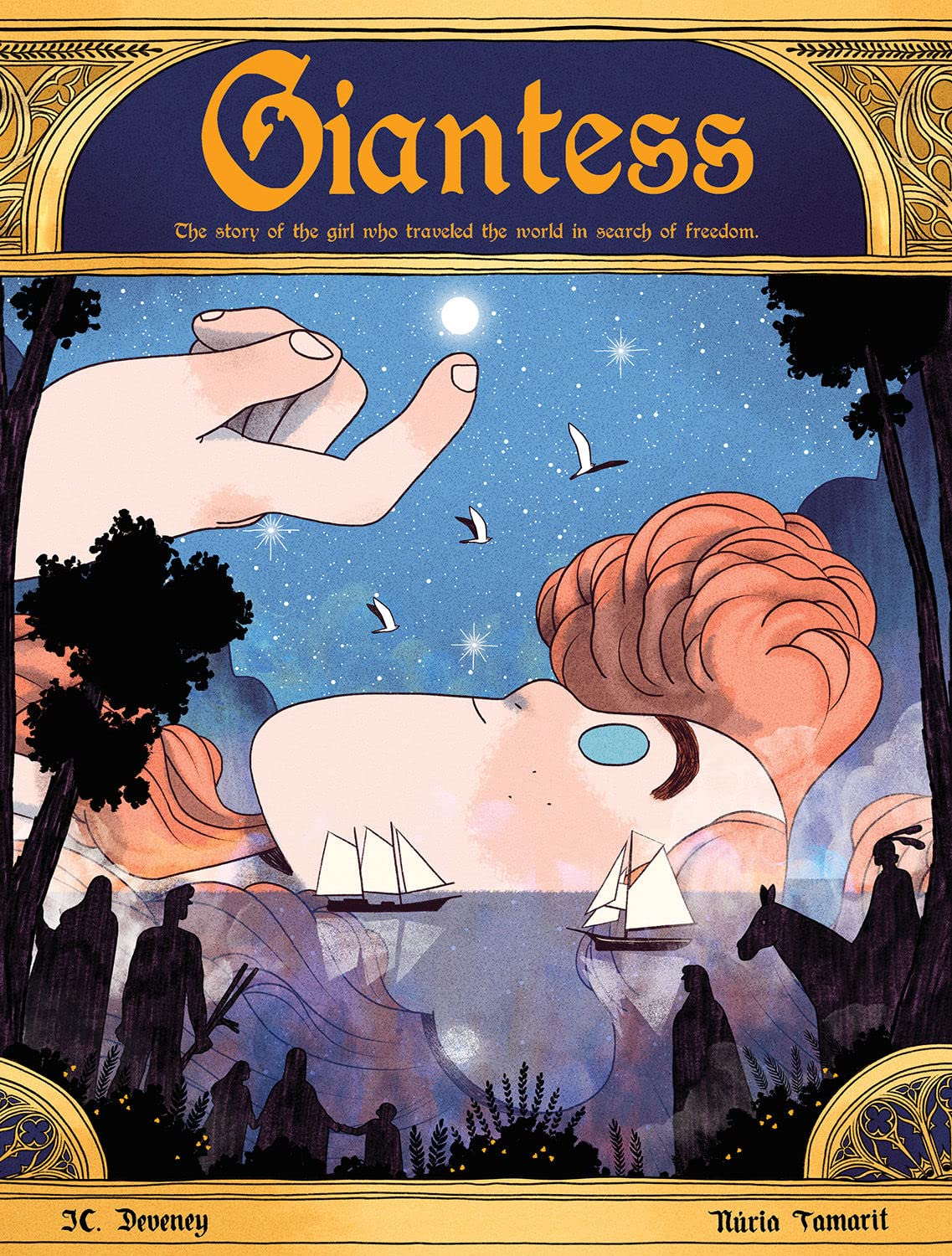
I purchased Giantess from Kickstarter. It's a recent French graphic novel that tells a fairy-tale-like fantasy story about Celeste, a giantess who goes on a long adventure trying to learn about the world, find a place in it, and live in a gender-egalitarian community.
 
The story opens with a family of farmers with six sons finding a giant infant and adopting her. As they grow up, the sons all go off to take their place in the world. Celeste wants to see things too, but her parents want to protect her. As a young woman she's already 20 or 30 feet tall, and I think she may keep growing throughout the book.
 
So, Celeste sneaks off with a traveling peddler to see a festival. She damages a building and runs away. She meets a knight sent to arrest her, who takes her to his castle. During the months of her pre-trial imprisonment, he falls in love with her. She decides to go home, and repels a foreign invasion along the way. She's rearrested, and placed in a dungeon with other woman, who are all being punished by a cruel inquisitor, who believes they all serve a witch. The inquisitor tries to burn them all at the stake, when they are saved ... by the witch!
 
The witch leads the women to the swamp, where she teaches them medicine and encourages them to teach others. Eventually Celeste leaves with an actress and joins her troupe. She falls in love with the tightrope walker. The troupe is invited to perform in a Venice-like city, then to stay. Celeste falls in love with the prince, and marries him, but cannot give birth to an heir. To save the royal face, she's sent to a convent, where she temporarily loses herself to religious fervor.
 
Eventually she escapes again, and goes to live on Greek-like island. She hears of a shipwreck, and goes to investigate the rumors of mermaids. She finds an island of women, but eventually learns it's as unequal as the wider world, in its own way. She escapes with the men and children, and they go to make their new home in an inaccessible valley near her original home.
 
Throughout the book, Celeste is portrayed as curious about the world, fond of books, and profoundly respectful to the tiny people around her. She learns medicine and uses her knowledge to help the poor. She observes the ways men and women are treated differently in traditional society, and longs for equality. In each of the places she stops, it's easy to imagine her becoming legendary, because she disrupts the local customs and forces them to do something new.
 
Celeste's movements through tbe world are often prompted, not just by her curiosity, but by love and her family. In each place she goes, she eventually re-meets one of her brothers, and their familial loyalty to each other is part of what prompts the changes she sets in motion in each place.
 
The art is very pretty, and the story feels at once classic and contemporary. Perhaps 'timeless' would be the right word. There are a lot of details that make Celeste's world feel like a playful reimagining of the real one, like almost Venice, or the mention of 'The Ulyssiad' as a source of mermaid stories right before Celeste sets of for the Themyscira-like island of women. Buying this one was probably the only way I was going to get to read it, and I'm glad I did.

Tuesday, June 14, 2022

The Very Nice Box


The Very Nice Box
by Laura Blackett and Eve Gleichman
Mariner Books
2021
 
 
The Very Nice Box is kind of a wild ride. It has a great cover illustration that makes it look like a contemporary romance novel, and it includes a romance plot, but it's not so straightforward. It's also a workplace comedy, a satire, and character study of its protagonist, and in places even a thriller.
 
We follow Ava, a senior engineer of containers at STADA, an IKEA-like design firm that makes things like thr Practical Sofa, the Precise Wristwatch, and Ava's current project, the Very Nice Box. Ava starts the novel very serious and proper, in part because she's still grieving over a car crash that killed her girlfriend and parents several years earlier. She likes her work and her routines, and has no time or interest in anything else.
 
Ava's orderly life is upset by a series of changes at work. Mat, a handsome bro in marketing gets promoted and starts all kinds of positivity and wellness initiatives - including mandating that everyone either attend a certain number of seminars or use the SHRNK psychiatry app, which Ava does. Also protestors are targeting STADA's new building. 
 
When Ava's car gets vandalized, she gets a ride home from Mat, develops a crush, and following the advice of her SHRNK, pursues the relationship, even though all the turmoil restarts traumatic flashbacks to the crash. Despite the stress, and Mat's bro-y flaws, she finds herself falling in love.
 
HR finds out about the relationship and sends Mat to Ohio. Ava goes on a couple dates (one with a man, one with a woman,) but still misses him. He comes back and moves in, and finally the glow begins to wear off. Ava has to decide if she really likes Mat, or if it was just short-term infatuation.
 
Woven through are a couple mysteries - who is behind the increasingly surreal STADA protests?, and what secrets from Mat's past explain why he joined the Good Guys, a group that seems halfway between AA and a redpill organization? While I don't want to give away the answers, I will say that the last few chapters are a rollercoaster of excitement and tension.
 
The style of the prose shifts over the course of the book to match Ava's shift from being compacted by grief to opening back up. Queerness is presented casually and treated normally. The parodic elements (mostly aimed at companies and corporate jargon) are genuinely funny, but there's also a much sharper critique of certain aspects of contemporary heterosexuality and masculinity that grows throughout and drives the conclusion of the story. I came in looking for light-hearted romance and double entedres, and got much more than I expected!

Monday, June 6, 2022

Missoula


Missoula
Rape and the Justice System in a College Town
by John Krakauer
Doubleday
2015
 
 
From time to time, many of my coworkers will all read the same book. This time it was Missoula. (Look for me to read the enigmatic 7HEH at some point, for the same reason!)
 
Krakauer delivers what I understand to be his signature style of present-day reporting inter-mixed with historical background and relevant scientific research in a way that's engaging and impactful. It feels strange to call a book like this a page-turner, but certainly it's one I wanted to keep reading.
 
Missoula covers the cases of several acquaintance rapes, almost all involving football players, that took place at the University of Montana between 2008-2012, at a time when both UM and the town of Missoula were under investigation by the Department of Justice for their handling of reported rapes.
 
Krakauer uses one case, of a young woman who was raped by a childhood friend after he joined the UM football team, as the centerpiece of the book. He was expelled, arrested, pleaded guilty, sentenced to prison, and had his appeal for a more lenient sentence rejected. Along the way, we look at other cases where accused rapists are allowed to remain at school, are never arrested, or are found not guilty at trial. 
 
The one successful case is probably only successful because the rapist confesses to his crime on tape. Even then, the fans remain behind him, and each judicial decision requires the victim to advocate forcefully for him to face consequences. Every other case results in the rapist escaping any consequences.
 
Krakauer covers the current research on 'non-stranger rape.' About 25% or more of women will be raped in their lifetimes, usually while they're between the ages of 16-24, usually by someone they know, and most will never report it to the police. It's a much smaller proportion of men who rape, perhaps 5-10%, but almost all of those men become serial rapists, each responsible for hurting numerous others. They generally don't think of themselves as 'rapists' or what they do as 'rape,' and most are never punished. Police and the public tend to think that about half the women who accuse someone of rape are lying; in fact fewer than 10% of accusations appear to be false. Women who are raped by an acquaintance rather than a stranger, and women who consumed any drugs or alcohol beforehand, are less likely to be believed.
 
Acquaintance rape is a crime, it's against the law, but laws alone are not enough. Laws are just words on paper unless people are willing to enforce them. So if it's a crime, but the police won't arrest, prosecutors won't indict, juries won't convict, and the public won't believe, then it's a crime that will only rarely be punished, only under exceptional circumstances, like if the police record a confession, and the victim has both the stamina and social support to endure the trauma of multiple rounds of adversarial legal procedures. 
 
What we see in Missoula is that for a significant proportion of both the general public and the people with jobs in the criminal justice system, things like the local celebrity status of playing football and adages like 'boys will be boys' are enough to prevent those laws from being enforced in most cases. Although UM and Missoula were investigated by the DOJ, they are, unfortunately, very typical of colleges and town in America.

Monday, February 21, 2022

Monster, She Wrote


Monster, She Wrote
The Women Who Pioneered Horror and Speculative Fiction
by Lisa Kroger and Melanie Anderson
2019
 
 
Monster She Wrote is a history of the most famous and influential women to write Gothic fiction, whether their works would be classified as horror, scifi, fantasy, or just 'literature.' Each author gets 3-5 pages of a vignette biography and discussion of her major works.
 
Most of the book is divided into chronological sections, covering the authors who originated 'the Gothic' like Mary Shelley and Anne Radcliffe, pulp authors from the early 20th Century, the writers of lurid paperbacks from the 80s and 90s, and a few sections in between. The last chapter is organized thematically, and it's overstuffed with names and recommendations.
 
I thought the earlier sections were stronger, but I appreciate Kroger and Anderson's willingness to try to wrestle the plethora of more recent works into a kind of canon to accompany the more-established earlier ones. They certainly offer a lot of help if you want to craft your own Gothic reading list.