Friday, March 10, 2023

The Inugami Curse


The Inugami Curse
by Seishi Yokomizo
translated by Yumiko Yamakazi
Pushkin Press
1972, reprinted 2020
 
 
The Inugami Curse is a Japanese mystery novel. Originally published in 1972, and just recently translated into English, it's set in the immediate aftermath of WWII, with soldiers returning home from the war playing key roles in the plot. Yokomizo wrote a series of mysteries featuring detective Kindaichi - according to the publisher of the translation, this one is the best-known in Japan. My sister was reading it last year while we were both in Ohio, which is how I learned about it.
 
The patriarch of the wealthy and powerful Inugami family, and founder of the family-owned silk manufacturing company, has died, and so the extended family has gathered at the family estate to learn how the inheritance will be divided. Detective Kindaichi is there too, because the family's lawyer is afraid that the reading of the will is going to lead to murder.
 
The old man never married, but he had three mistresses and a daughter with each mistress; each daughter had a son, and the three grandsons have been helping to run the company. The oldest grandson (son of the oldest daughter) is Kiyo. There are months of delay after the old man's death before the will is read to wait for Kiyo to return home from the war. When he does, his face is disfigured by injury, and his mother has commissioned a creepy rubber mask that looks like his old face for him to wear at all times. The other family members wonder if this is really Kiyo, or if his mother has disguised an imposter to secure her share of the fortune.
 
In addition to those grandsons, there's a girl Tamayo who's the same age. She's the granddaughter of a local priest who served as the old man's benefactor before he became rich. (The old man and the priest are also rumored to have had a gay affair.) Tamayo has an adopted brother who acts as her bodyguard. There's also another grandson, this one a secret, the same age as the others, whose mother was a much younger mistress, that the three daughters frightened into running away shortly after she gave birth. His location is unknown.
 
So, the will gives Tamayo a few months to pick one of the three main grandsons to marry. The couple will inherit everything, and the others nothing. If all three grandsons die before the time is up, Tamayo alone gets everything. If Tamayo dies or doesn't marry before the time's up, the main grandsons each get ⅕ of the fortune and the secret grandson gets ⅖. If any of the main grandsons die, their share goes to the secret grandson, but if he dies, his share goes to charity. 
 
It's kind of a complicated set-up! Naturally, everyone is upset by the will. Kindaichi observes that it gives the main grandsons a motive to kill their half-brothers, and/or to rape Tamayo to force her into marriage, Tamayo a motive to kill the three main grandsons, and the secret grandson a motive to kill all the others.
 
Sure enough, during the months before the marriage deadline, two of the grandsons are killed, seemingly by a soldier with a hidden face, who's variously suspected to be either Tamayo's adopted brother, or Kiyo, or the secret grandson. We learn the true nature of the old man's relationship with his benefactor, the truth about what the three sisters did to the other mistress, and in general, we see almost everyone revealed as violent, amoral, and selfish. Finally there's a third murder, and then Kindaichi solves the case, too late to do very much good.
 
Yokomizo's writing uses a lot of short sentences. It's generally very direct, even journalistic. But he also editorializes sometimes! Yokomizo tells us there will be murders from the beginning, points out every time Kindaichi misses a clue or fails to realize something, and passes moral judgment on the characters and their actions. I liked the foreshadowing, but wished he'd trust me to know that murder is bad without him needing to be preachy about it. In this translation at least, he overuses 'demonic' as a descriptor for the crimes, says they're 'chilling' and 'straight from hell' and so on, to an extent that I thought sort of detracted from his otherwise very straightforward prose.

Tuesday, March 7, 2023

Moose's Book Bus


Moose's Book Bus
by Inga Moore
Candlewick Press
2021
 
 
My sister recommended Moose's Book Bus to me, and it's pretty cute! It's sort of a fable about why, if public libraries and public education didn't exist, you'd want to invent them.
 
Moose tells his family a story every night, but eventually he's told all the stories he knows so many times that he wants something new. He goes to all his forest neighbors, but none of them have any story books. So he travels to the city to check out some library books there. Now story time is new and exciting, and his neighbors start showing up to listen. This is nice, but Moose's house is getting crowded.
 
So he goes back to the city library with a plan, and sets up a book bus that he can take back to the forest. His neighbors think this is nice, but they don't know how to read. So Moose teaches some of them, and some teach the others. Then they all start checking out library books from the book bus, to enjoy reading at home. They also still have communal story times at several houses, but now that they can all host, it doesn't get over-crowded like before.
 
Like I said, a cute little story about the importance of public services and civic involvement, and the drawings of forest animals are also very sweet.

Monday, March 6, 2023

Justice League: Death Metal


Justice League: Death Metal
DC Comics
2021
 
 
Justice League: Death Metal is the final companion volume to Dark Nights: Death Metal. It tells a single story that expands on something that happens in a couple of panels in the original - after Wonder Woman freed Superman and all the other captured superheroes from evil Darkseid-Batman's prison, Nightwing led a mission to rescue the Legion of Doom and sabotage the antenna that Batman Who Laughs was using to receive 'crisis energy' from the remnants of the multiverse.
 
So, we follow a very motley team of Nightwing, Hawkgirl, Starfire, Cyborg, Detective Chimp, and Lex Luthor as they attempt to save some of the worst supervillains on Earth from being used as parts in an evil machine. They have to fight evil Starro-Batman and evil Martian-Manhunter-Batman along the way, and then immediately fight the villains they rescued. Also, no one trusts Lex Luthor, which seems wise.
 
Nightwing's thoughts provide all the voiceover narration throughout, making this a story that's focused on Dick Grayson's character development at least as much as it is on the rescue mission. It's most similar to the Flash and Green Lantern stories from the first companion volume, and probably belongs up front there, rather than being saved for the end.

Friday, March 3, 2023

The Hod King


The Hod King
by Josiah Bancroft
Orbit
2019
 
 
The Hod King is the third book in a quartet, following Senlin Ascends and Arm of the Sphinx. The story started with one hapless man trying to find his lost wife, who he got separated from within minutes of their arrival at the Tower of Babel for their honeymoon. Early on, I thought he would wander his way to the top, encountering some sort of 'sorry Mario but your princess is in another castle' scenario in every floor along the way. Fortunately the series is much better than that.  By now Senlin has made friends, they've become air pirates, and are now on an espionage mission assigned by the mysterious Sphinx...
 
Bancroft has two talents that have served him well so far. The first is seeding the early parts of his books with clues and mysteries that all come together in moments of revelation further in. The second is setting expectations at each point for what might happen next, and then finding some way to do something better and more interesting. 
 
And despite the steampunk technology and fantastical vertical city setting, the problems within the Tower are all too realistic - class and gender inequality, slavery, the corrupt rule of self-serving elites. I daresay Bancroft might be a feminist. He certainly writes a variety of women characters well, and he depicts complaints about rich men that you rarely hear other men voice.
 
This book is split into three sections as we observe the events of about a week from three different viewpoints. First Senlin, disguised as a tourist, sent to investigate the coliseum where enslaved 'hods' fight as gladiators. But since his wife Marya lives on this ring of the Tower with her new rich husband, Senlin can't resist the chance to finally make contact. This goes poorly, and Senlin is enslaved and sent to live among the hods, where he reconnects with some characters from previous books who blame Senlin for their own enslavement.
 
In the second section, acrobatic Voleta tries to enter high society by being introduced with great fanfare as the Sphinx's niece. Her mission is to contact Marya while Senlin and Edith do their political spying. She finds the competitive upper-class partying on this ring almost unbearable. Accessing Marya also means dealing with several men from the royal family, who turn out to be much more dangerous than she expected.
 
In the third section, Edith acts as the Sphinx's official emissary to the local government. She befriends another woman with cybernetic implants from the Sphinx, but this other 'Wakeman' has been operating without new orders for over a decade. She's trying to do right, but no longer really trusts the Sphinx any more than she likes the locals. Also, the royal family and their guards decide to either seize the Sphinx's airship or blow it out of the sky!
 
One of my friends described this book as the Empire Strikes Back of the series, and I think it's an apt comparison. Our heroes end up outsmarted and beaten back at every step, one captured, several injured, one killed. But they also make new allies, and maybe find themselves in a position to succeed in the Sphinx's mission next time...

Thursday, March 2, 2023

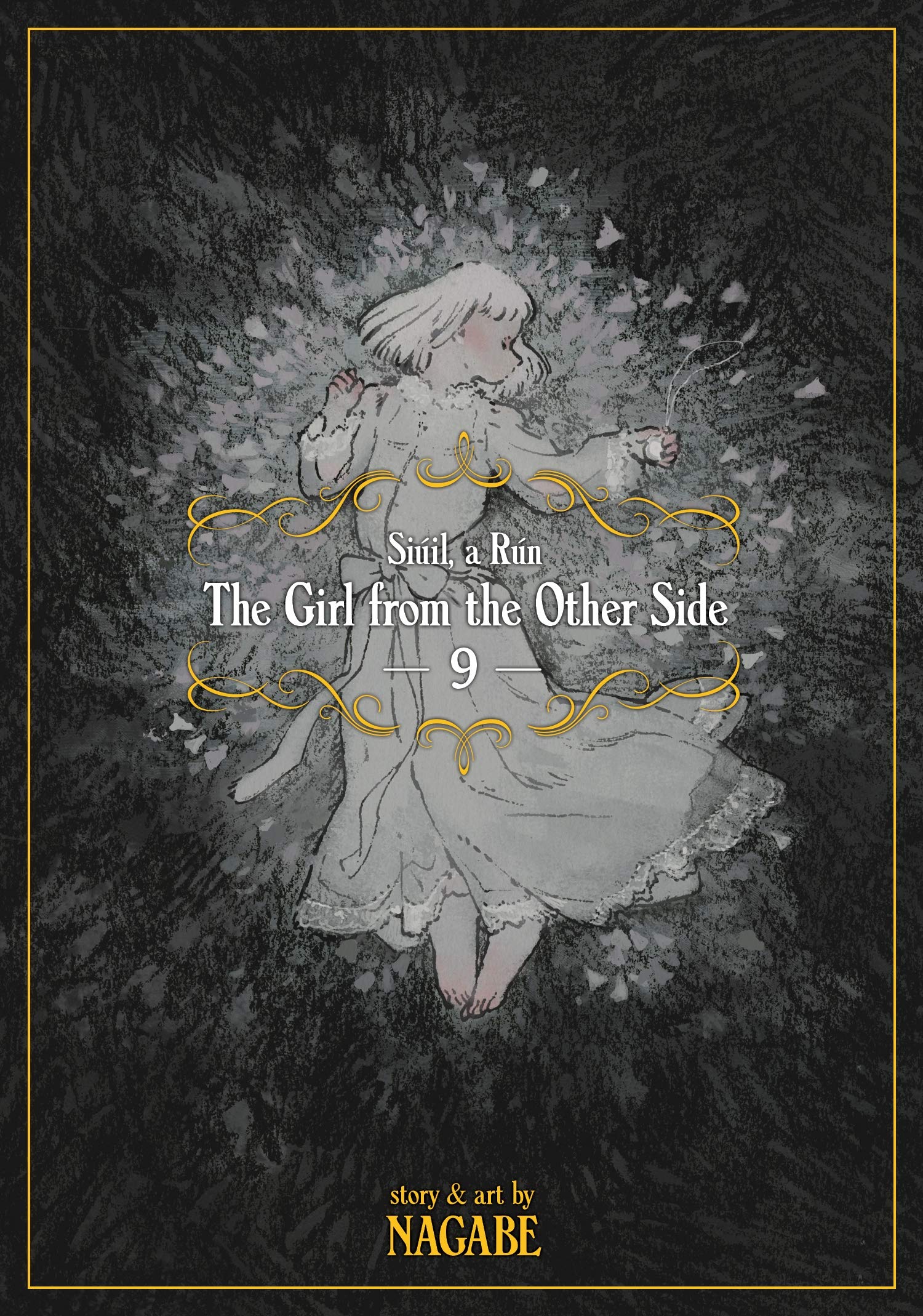
The Girl from the Other Side 9


The Girl from the Other Side 9
Siuil, a Run
by Nagabe
Seven Seas
2020
 
 
In the ninth volume of The Girl from the Other Side, we come closer and closer to a final conclusion.
 
Shiva is still locked in the capital dungeon while the king heals from his heart attack. A soldier who feels guilty about kidnapping her checks on her and recognizes the locket. He says it belonged to his friend, from a village that the royal army burned down because of a curse outbreak. He also notes that Shiva is the right age to be his friend's daughter, except of course it's impossible, because the friend and daughter both died with the rest of the village, right? Hmm...
 
The king follows the high priest to a secret sanctum, where he finds a bunch of forbidden revelations from their god. The king learns a new version of the creation story. Instead of 'the God of Light made the world, the God of Dark stole parts of it, creating the curse,' we learn that the Sky Father and Earth Mother made the world, and humanity, together, and the curse is somehow the result of an acrimonious divine divorce. The Father tried to kill the Mother, and stole part of her body to make more human souls. Somehow he lost his own body in the process, that became the Outsiders.
 
The king is pretty shocked, and realizes that the point of sacrificing Shiva isn't to somehow use her soul to cure the curse, it's just so that the Father can get a little bit of his body back. The king balks at killing a little girl for what he considers an unworthy reason, so the priest stabs him and goes to complete the sacrifice ritual himself.
 
The soldier who felt guilty wants to stop the sacrifice too. He goes and finds the king. The king interrupts the ceremony, he and the priest argue publicly, and the public sides with the priest, who is perfectly willing to lie to get what he wants. But meanwhile the soldier has already snuck Shiva away. He takes her to the forest, where she finds Teacher.
 
Teacher has turned into a tree, but Shiva holds his branch-hand and it turns back into a hand, while Shiva turns into an Outsider too. The final image is a restored Teacher (restored to being an Outsider, not to being human) holding hands with Shiva, who has turned into a tree.
 
The next volume is the last one, so we'll discover what happens to Shiva and Teacher, and what happens to humanity generally.

Tuesday, February 28, 2023

The Multiverse Who Laughs


Dark Nights: Death Metal
The Multiverse Who Laughs
2021
 
 
The Multiverse Who Laughs is another volume of companion material to Dark Nights: Death Metal, and I'm beginning to wish I'd just stop with the original. 
 
The main story was fast-paced, overflowing with ideas, and has a fun sort of energy. These extra stories do sometimes add new ideas, but they're also almost all riffing on something already seen, and their structure as interstitial vignettes makes it difficult to carry much narrative momentum.
 
We get a longer evil Robin-Batmam story, a Lobo vs evil Lobo-Batman story, a Superboy Prime redemption story, and more shorts, including a Watcher-like figure wandering through the conflict on a sightseeing tour, and a Dark Multiverse story where the League of Super Pets get super rabies and kill everyone on their particular Dark Earth.
 
There's one companion volume left, and I'm going to read it, I think, but I'm also reevaluating how much I want to read of these giant crossover events in the future.
 
I really thought one of these volumes was going to expand on what happens to Batman, Superman, and Wonder Woman when they travel to the worlds where the good guys are perpetually losing the Infinite Crisis, Final Crisis, and Crisis on Infinite Earths, because that seemed like the part of the story that would most benefit from a longer retelling. Not least because unless you super remember what happened originally, (which I don't,) it's hard to even understand how the Dark Multiverse versions are different, to say nothing of why. So fingers crossed that that's what's next!

Thursday, February 23, 2023

Nutcracker Nation


Nutcracker Nation
How an Old World Ballet Became a Christmas Tradition in the New World
by Jennifer Fisher
2003
 
 
In Nutcracker Nation, Fisher looks at the history of The Nutcracker in America and the meaning it holds for both dancers and audiences.
 
In America, The Nutcracker is an annual Christmas tradition, the single biggest money-maker for dance companies, the one ballet that nearly every dance student has performed, the ballet that people are most likely to have attended as an audience member, and the show that critics and 'serious' ballet fans and performers feel the most ambivalent about. So it's popular, loaded with extra meaning as a holiday tradition and childhood rite of passage, and as a result, a bit maligned by the people most interested in ballet for its aesthetic qualities and association with status.
 
Fisher starts with a history of The Nutcracker. It was first produced in Russia in the 1890s, but had little commercial or critical success there. An animated version was included in Disney's Fantasia. In the postwar years, it began to become an annual tradition in the US, helped along by several tv specials in the late 1950s. It acts as an 'invented tradition' - a relatively recent ritual that has the appearance of being much older, in part because it uses symbols that represent contemporary ideas about the past.
 
Fisher then discusses both the 'traditional' Nutcracker and some of the many variations meant to modernize it, or address gender issues, or make it more appealing to aesthetes, or make it more relatable, either to popular audiences or specific ethnic communities. She also explores the ethnic stereotypes that are usually incorporated into certain dances, and some of the ways ballet companies have tried to change those. This section draws on her observations attending a really wide variety of performances.
 
Fisher also conducted ethnographic research, attending rehearsals and performances for one amateur suburban dance company and one major urban one. She interviewed dancers, the stage crews, volunteers, and audience members.
 
The Nutcracker is always a community production. In addition to the roles for professionals, there are parts for children and teen ballet students, and sometimes extras of all ages to fill out certain crowd scenes. There is no one canonical choreography. Although certain arrangements are more or less handed down from key early productions, each dance troupe is essentially forced to interpret it in their own way. And many enjoy the chance to do something specific and local.
 
For ballet students, The Nutcracker is an opportunity to see themselves advancing in both age and skill. Many adult women have memories of ballet lessons and dancing The Nutcracker when they were girls, and it's often something from their own childhood that mothers can share with daughters.
 
Despite their artistic ambivalence, dance companies like the revenue the show brings in, often like the ritual aspect as well, and sometimes like the chance to do something lower stakes, fun, and universally beloved. And while most dance students move on to other careers, essentially every professional ballet dancer was once a mouse, a snowflake, a flower.