Thursday, March 2, 2023

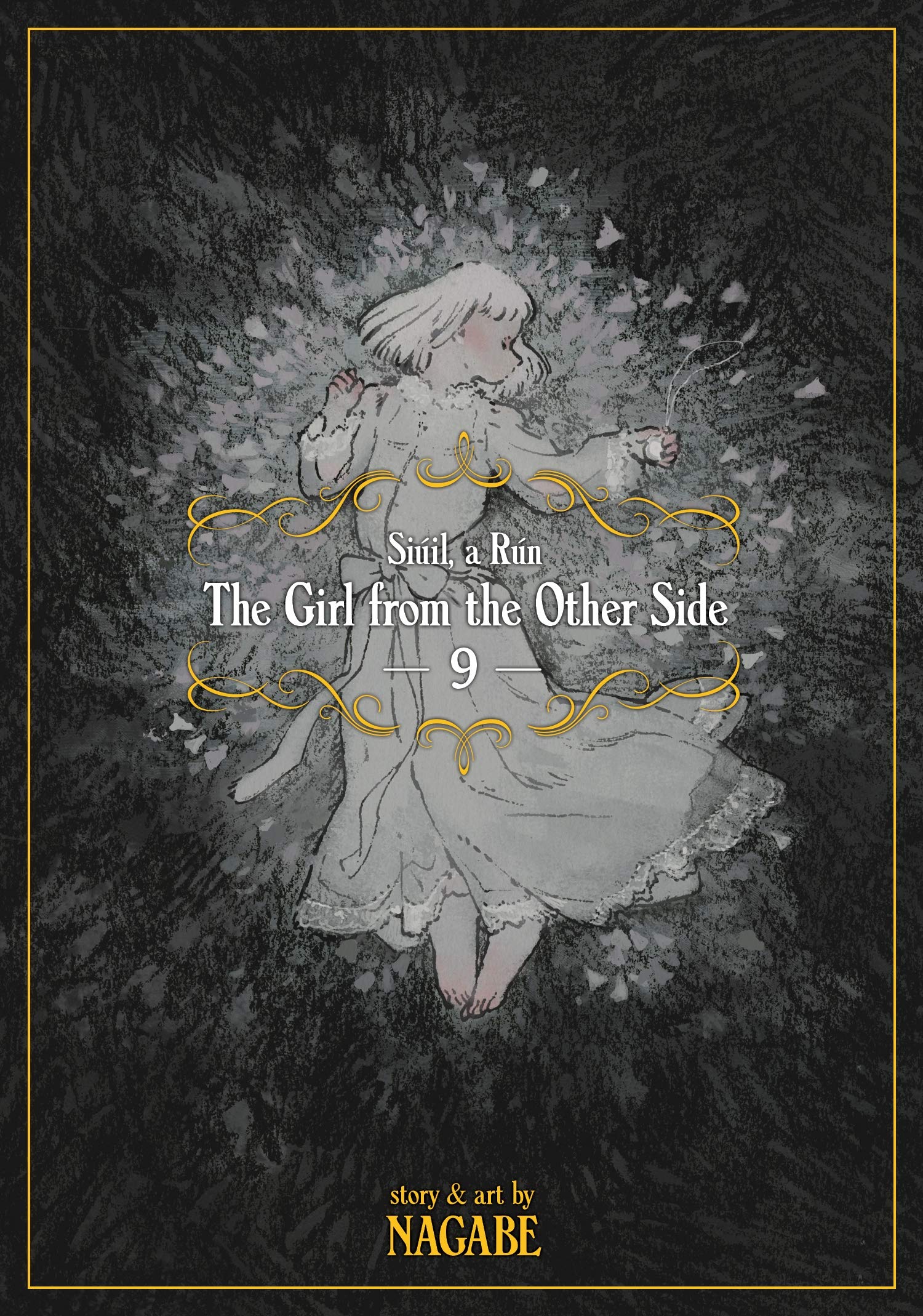
The Girl from the Other Side 9


The Girl from the Other Side 9
Siuil, a Run
by Nagabe
Seven Seas
2020
 
 
In the ninth volume of The Girl from the Other Side, we come closer and closer to a final conclusion.
 
Shiva is still locked in the capital dungeon while the king heals from his heart attack. A soldier who feels guilty about kidnapping her checks on her and recognizes the locket. He says it belonged to his friend, from a village that the royal army burned down because of a curse outbreak. He also notes that Shiva is the right age to be his friend's daughter, except of course it's impossible, because the friend and daughter both died with the rest of the village, right? Hmm...
 
The king follows the high priest to a secret sanctum, where he finds a bunch of forbidden revelations from their god. The king learns a new version of the creation story. Instead of 'the God of Light made the world, the God of Dark stole parts of it, creating the curse,' we learn that the Sky Father and Earth Mother made the world, and humanity, together, and the curse is somehow the result of an acrimonious divine divorce. The Father tried to kill the Mother, and stole part of her body to make more human souls. Somehow he lost his own body in the process, that became the Outsiders.
 
The king is pretty shocked, and realizes that the point of sacrificing Shiva isn't to somehow use her soul to cure the curse, it's just so that the Father can get a little bit of his body back. The king balks at killing a little girl for what he considers an unworthy reason, so the priest stabs him and goes to complete the sacrifice ritual himself.
 
The soldier who felt guilty wants to stop the sacrifice too. He goes and finds the king. The king interrupts the ceremony, he and the priest argue publicly, and the public sides with the priest, who is perfectly willing to lie to get what he wants. But meanwhile the soldier has already snuck Shiva away. He takes her to the forest, where she finds Teacher.
 
Teacher has turned into a tree, but Shiva holds his branch-hand and it turns back into a hand, while Shiva turns into an Outsider too. The final image is a restored Teacher (restored to being an Outsider, not to being human) holding hands with Shiva, who has turned into a tree.
 
The next volume is the last one, so we'll discover what happens to Shiva and Teacher, and what happens to humanity generally.

Tuesday, February 28, 2023

The Multiverse Who Laughs


Dark Nights: Death Metal
The Multiverse Who Laughs
2021
 
 
The Multiverse Who Laughs is another volume of companion material to Dark Nights: Death Metal, and I'm beginning to wish I'd just stop with the original. 
 
The main story was fast-paced, overflowing with ideas, and has a fun sort of energy. These extra stories do sometimes add new ideas, but they're also almost all riffing on something already seen, and their structure as interstitial vignettes makes it difficult to carry much narrative momentum.
 
We get a longer evil Robin-Batmam story, a Lobo vs evil Lobo-Batman story, a Superboy Prime redemption story, and more shorts, including a Watcher-like figure wandering through the conflict on a sightseeing tour, and a Dark Multiverse story where the League of Super Pets get super rabies and kill everyone on their particular Dark Earth.
 
There's one companion volume left, and I'm going to read it, I think, but I'm also reevaluating how much I want to read of these giant crossover events in the future.
 
I really thought one of these volumes was going to expand on what happens to Batman, Superman, and Wonder Woman when they travel to the worlds where the good guys are perpetually losing the Infinite Crisis, Final Crisis, and Crisis on Infinite Earths, because that seemed like the part of the story that would most benefit from a longer retelling. Not least because unless you super remember what happened originally, (which I don't,) it's hard to even understand how the Dark Multiverse versions are different, to say nothing of why. So fingers crossed that that's what's next!

Thursday, February 23, 2023

Nutcracker Nation


Nutcracker Nation
How an Old World Ballet Became a Christmas Tradition in the New World
by Jennifer Fisher
2003
 
 
In Nutcracker Nation, Fisher looks at the history of The Nutcracker in America and the meaning it holds for both dancers and audiences.
 
In America, The Nutcracker is an annual Christmas tradition, the single biggest money-maker for dance companies, the one ballet that nearly every dance student has performed, the ballet that people are most likely to have attended as an audience member, and the show that critics and 'serious' ballet fans and performers feel the most ambivalent about. So it's popular, loaded with extra meaning as a holiday tradition and childhood rite of passage, and as a result, a bit maligned by the people most interested in ballet for its aesthetic qualities and association with status.
 
Fisher starts with a history of The Nutcracker. It was first produced in Russia in the 1890s, but had little commercial or critical success there. An animated version was included in Disney's Fantasia. In the postwar years, it began to become an annual tradition in the US, helped along by several tv specials in the late 1950s. It acts as an 'invented tradition' - a relatively recent ritual that has the appearance of being much older, in part because it uses symbols that represent contemporary ideas about the past.
 
Fisher then discusses both the 'traditional' Nutcracker and some of the many variations meant to modernize it, or address gender issues, or make it more appealing to aesthetes, or make it more relatable, either to popular audiences or specific ethnic communities. She also explores the ethnic stereotypes that are usually incorporated into certain dances, and some of the ways ballet companies have tried to change those. This section draws on her observations attending a really wide variety of performances.
 
Fisher also conducted ethnographic research, attending rehearsals and performances for one amateur suburban dance company and one major urban one. She interviewed dancers, the stage crews, volunteers, and audience members.
 
The Nutcracker is always a community production. In addition to the roles for professionals, there are parts for children and teen ballet students, and sometimes extras of all ages to fill out certain crowd scenes. There is no one canonical choreography. Although certain arrangements are more or less handed down from key early productions, each dance troupe is essentially forced to interpret it in their own way. And many enjoy the chance to do something specific and local.
 
For ballet students, The Nutcracker is an opportunity to see themselves advancing in both age and skill. Many adult women have memories of ballet lessons and dancing The Nutcracker when they were girls, and it's often something from their own childhood that mothers can share with daughters.
 
Despite their artistic ambivalence, dance companies like the revenue the show brings in, often like the ritual aspect as well, and sometimes like the chance to do something lower stakes, fun, and universally beloved. And while most dance students move on to other careers, essentially every professional ballet dancer was once a mouse, a snowflake, a flower.

Thursday, February 16, 2023

War of the Multiverses


Dark Nights: Death Metal
War of the Multiverses
 
 
War of the Multiverses is another companion volume to the main Dark Nights:Death Metal story. There are two issues in here, the first a collection of very short comics about how various heroes spent their last night before the final battle, the second another collection of shorts showing various heroes fighting their evil multiversal counterparts while giant metal Wonder Woman dukes it out with giant evil Batman Who Laughs.
 
I mean no disrespect when I say that some comicbook writing has a very fanfic sensebility to it. You like Silver Age Superman? Here's a comic about his girlfriend Lois Lane, and the mischief she gets up to in between his issues. Here's another comic about his best friend Jimmy Olsen, and the mischief he gets up to. Here's a whole comic of retrocontinuity flasbacks to Superman's childhood adventures as SuperBOY in Kansas. Here's a comic about the time Superboy went 1000 years in the future, in between issues of the other comic. Etc.
 
To say nothing of the content of these stories, I associate fanfic with the urge to 'fill in the setting' by telling new stories that take place in between the major plot events and showing what minor characters were supposedly up to while they were off-camera. (In terms of content, there might be particular kinds of stories that often get slotted into those positions, but let's leave that aside for now.)
 
If this extra material had been interwoven with the main story, maybe it would have made the whole thing seem grander and more epic. Although honestly, there might simply be too much material here for that technique to work, even in an omnibus edition.
 
But collected separately like this, and read afterward, these vignettes feel like fanfic elaborations. Which is not to say I didn't enjoy any of them! They varied a lot in quality. I liked all the various Teen Titans having a low-key party before the big fight, and weirdly, the Penguin fighting his even eviler twins was one of the best battle stories.

Wednesday, February 15, 2023

The Girl from the Other Side 8


The Girl from the Other Side 8
Siuil, a Run
by Nagabe
2020
 
 
The eighth volume of The Girl from the Other Side ushers in some big changes and brings us to what I think must be the endgame for the series.
 
After all the excitement with the soldiers in the previous volume, Shiva is briefly missing and Teacher goes searching for her. She had gone out searching too, for his missing locket with the photo he thinks is of his wife and child. Shiva isn't bothered at all by the cold, which is a bad sign. The Curse is spreading across more of her body.
 
Teacher decides to save Shiva and uses a soldier's sword to pierce his own chest. Inside, instead of a heart, there's a ball of light - a soul. He asks Shiva to reach in and take it. She does, and by the next morning, she's fully cured - but Teacher has lost his memory. He passively accepts her instructions as she tries to walk him through a familiar day, but it becomes clear that without his soul, he's lost whatever was making him different from other cursed people.
 
Soldiers find them again, and Teacher wanders off rather than try to defend Shiva. They take her to the castle in the capitol city and put her in the dungeon. The king is supposed to perform a ceremony where he sacrifices her on an altar in the central cathedral, but has a heart attack and collapses right before he can kill her.
 
Shiva is escorted back to the dungeon, and presumably the capitol is in turmoil, although we don't see that. A mysterious stranger, who we can't see, gives Shiva back the locket, and encourages her not to give up hope. She can't escape, and assumes she'll never see Teacher again, but maybe having an ally gives her some will to live.
 
Meanwhile, back in the forest, Teacher seems to be starting to turn into a tree...

Tuesday, February 14, 2023

There is No Antimemetics Division


There is No Antimemetics Division
by qntm
2021
 
 
Like The Fifth Science, which I read last year, There is No Antimemetics Division is another book that the Amazon algorithm is relentlessly convinced it should offer me at every opportunity. Fortunately, the public library bought a copy of this one too!
 
So, 'meme' is a real concept. It refers to the cultural equivalent of a gene, an idea that 'reproduces' because people share it with other people. 'Antimeme' is a made-up concept that refers to ideas that are supernaturally self-censoring - mostly things that are invisible because you look past them instead of at them without realizing it (like the 'somebody else's problem' field from The Hitchhiker's Guide) and things you can't remember when you're not currently interacting with them (like The Silence from Dr Who or the main character from Larry Niven's The Gift from Earth.)
 
There is No Antimemetics Division is based on the fake encyclopedia entries and lore of the SCP Foundation website, and may have originally been published in its entirety there. In this fiction, The Foundation is a secret organization that protects the world from dangerous supernatural anomalies. The Antimemetics Division is responsible for protecting us from any threats that either attack or camouflage themselves with antimemes.
 
The plot here is a kind of scifi spy thriller that roughly follows Marion Wheeler, the head of Antimemetics as she and her staff handle a few routine threats (only sometimes successfully) and repeatedly rediscover a big world-ending threat. 
 
The problem is, the world-ender, #3125 in their database, is approaching human idea space from outside reality. When it gets here, it will take over every human mind by becoming the only thought anyone is capable of thinking (like anti-life in DCeased), but while it's still only arriving, it kills anyone who becomes consciously aware of it. So to fight it, you need an antimeme-shielded workspace to develop a solution, ways to convince yourself to go back to the safe space repeatedly to keep working, and ways to keep yourself from asking questions or getting ideas that will kill you when you're not shielded.
 
Marion figures the situation out, thinks she and her team might have already created the solution, and gets to the secure bunker just in time to avert doomsday ... except it turns out that they didn't have a solution, just a powerful antimeme bomb to temporarily stop the killing by making everyone forget what they've learned about the alien idea so far.
 
Then, we pick up following Marion's husband Adam. (Due to a workplace accident prior to the novel's start, they'd both forgotten the other existed.) He witnesses the arrival of the alien idea and the subsequent end of the world. Then, the Idea of Marion, who has become a meme herself, saves him from endlessly thinking the same alien thought and turns him back into himself. 
 
Adam then sets out to save the world by locating the other site where the solution might already exist. Unfortunately, the solution is incomplete, but the idea of Marion Wheeler meme is able to act as the missing piece. The alien idea is defeated, and people can think again, with, of course, no memory of anything that's happened, and indeed no memory that anything has happened at all.
 
This is scifi for scifi nerds, probably not really intended for general audiences. Being an SCP fan might help, but I'm not, and I was fine. The writing is brisk and the plot is engaging. I think there could have been a bit more dramatic unity. Some things happen seemingly just to show off the possibilities of antimemetics that could have been made more central to the plot, and we get a few too many single-use characters when it might've been nice to combine them into a few recurring characters instead. But I had fun reading it, and especially if you're a fan of what I like to call Sapir-Whorf scifi, where ideas have supernatural power, you might like to consider it.

Saturday, February 11, 2023

Ace


Ace
What Asexuality Reveals about Desire, Society, and the Meaning of Sex
by Angela Chen
2020
 
 
I read a graphic memoir and a quick guide to asexuality last year, but Ace is the first book I'd recommend to someone else. I think it would be useful for anyone wanting to better understand asexuality for personal reasons, and honestly, would be good to read for anyone studying sexuality academically.
 
Chen is asexual herself, and conducted interviews with other aces, their partners, and some sociologists and other academics. The book is structured in three parts - first discussing the concept of asexuality; then looking at how it intersects with gender, race, and disability status; and finally looking at relationships, especially for couples where only one partner is ace. In each section, Chen recounts her own experiences, shares the stories of others, and weaves in academic concepts where appropriate. A running theme is that the asexual perspective can also illuminate aspects of sexuality that are true for everyone, but not always as easy to see.
 
Chen talks about the difficulty of realizing that you don't feel something most other people do, even when that something is as ubiquitous as sexual attraction, the desire to have sex with another person for the sake of feeling physical pleasure. Chen notes that we tend to act as though sexual attraction is always (or at least usually) felt at the same time as romantic attraction, aesthetic appreciation of someone's appearance, and desire for friendship. We also tend to act as though sexual attraction is the only reason people have sex. Neither is really true, and we sort of already know that, but non-aces rarely think about it.
 
Even though we know that there's natural variation in the amount of sexual attraction that people feel, we tend to act as though everyone both will and should form relationships on the basis of mutual sexual attraction, that sexual relationships are more important than non-sexual ones (with marriage legally and socially regarded as a person's most important relationship, and given special treatment in a multitude of ways), that sexual relationships are what make us 'real' adults and full participants in society, and that people in a romantic relationship kind of owe each other sex whether they really want it or not.
 
Chen discusses the fear she and many other asexual women feel, that wanting sex is seen as cool and feminist, so she fears her absence of desire will make her seem conservative, prudish, frigid, repressed. She discusses male ace's problem - that others find it much harder to believe that a man feels no attraction. She talks about navigating racial stereotypes, and the fraught relationship between the ace and disability communities. In brief, asexuals fear being stereotyped as 'sick' or 'broken,' in need of a cure or fix, and disabled people fear both being seen as undesirable and as not experiencing desire themselves.
 
Chen also talks about relationships between asexual and non-ace partners. She notes that asexual people can still want friendship, companionship, stability, commitment. They may want children. They may want to be desired by someone, even if they can't reciprocate. 
 
These relationships sound challenging, though Chen observes that almost all couples will experience some degree of mismatch between their levels of desire, and that couples who have enough reasons to stay together can live with an ongoing challenge, especially if they're willing to talk about it. And while she is insistent that no one should ever feel required to have sex they don't want, Chen also notes that people, including non-aces, are sometimes perfectly willing to have sex they don't actively desire because of other motives, such as wanting to please their partner or to strengthen the bond of the relationship.
 
I appreciated Chen's honesty about her own faults and doubts, the thoughtfulness of her writing, and the balance she struck between writing for other asexuals and for the benefit of non-ace readers.